
You can also get Class XII Practicals on Biology, Physics, and Physical Education.
Aim : To find the focal length of a convex lens by plotting graph between u and v.
Apparatus : An optical bench with three upright (central upright fixed , two outer uprights with lateral movements ), a convex lens with lens holder , two optical needle , (one thin , one thick ) a knitting needle and a half meter scale .
Theory : The relation between u , v and for a convex lens is
1/f= 1/v – 1/u Where f=focal length of convex lens
i/f = u-v/uv u =distance of object needle from optical center of the lens (-)
f =uv/u-v v = distance of image needle from optical from optical center of lens (+)
Procedure
- Mount the concave mirror in the mirror holder .
- Obtain the image of a tree or building outside of the window on a screen and move the mirror forward and backwards to get a sharp image on the screen .
- Measure the distance between mirror and screen (rough focal length ).
- Clamp the holder with lens fixed upright at 50cm mark .
- Adjust the lens so that its surface is vertical and upright keep it fixed .
- Take the thin optical needle as object needle (o).Mount it in outer laterally moveable upright near zero end .
- Move the object needle upright and clamp it at a distance nearly 1.5 times the rough focal length obtained earlier .
- Adjust height of the object needle to move its tip lie on a horizontal line through the optical center of the lens .
- Note the position of the index mark on the base of object needle .
- With the eye closed , see with the right eye from the other end of the optical bench . An inverted and enlarged image of the object needle will be seen .
- Mount the thick optical needle in the fourth upright near the other end of the optical bench .
- Adjust the height of the image needle (thick) so that its tip is seen in line with the tip of the image when seen with the right eye open .
- Move the eye towards right .The tip will get separated .The image tip and the image needle tip have parallax .
- Remove the parallax tip to tip .
- Note the position of the index mark on base of image needle .
- Record the position of the index mark on the base of upright of lens , the object and image needle .
- Find index correction (if any ) as described for distance between optical center of lens and tip of image or object needle .
- Move object needle upright towards mirror in steps of 1 cm to get observation .Repeat the experiment .
- Move object needle upright towards mirror in steps of 1 cm to get the rest of the observation . Repeat the experiment .
- Record your observation .
Result
F =uv /u-v f from u-v graph
Diagram
Focal length of convex lens
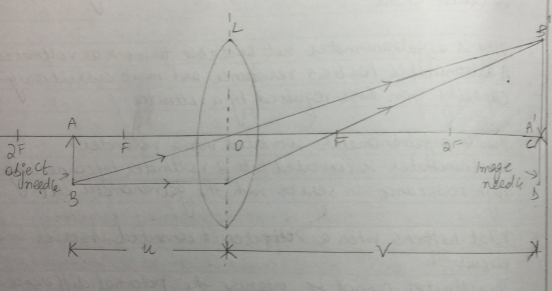
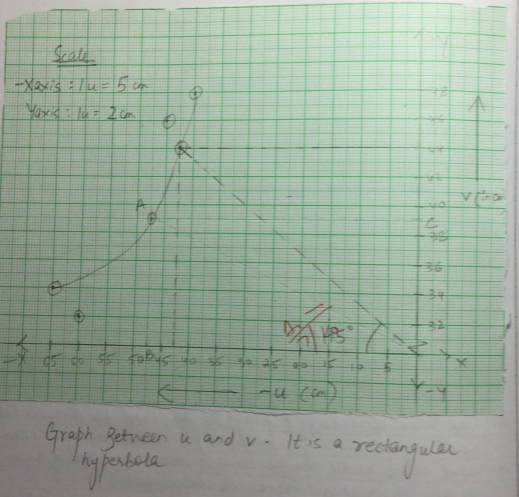
Observation table
| S No | Position of lens (cm) | Object length u (inch) | Image lens v
(in cm) |
Position of object | Position of image | 1/u | 1/v |
| 1 | 80 | 60 | 32 | 20 | 11.2 | 0.0107 | 0.0312 |
| 2 | 80 | 65 | 34 | 25 | 11.6 | 0.018 | 0.29 |
| 3 | 80 | 50 | 39.3 | 30 | 121.3 | 0.02 | 0.054 |
| 4 | 80 | 45 | 46 | 35 | 126 | 0.122 | 0.204 |
| 5 | 80 | 40 | 48 | 40 | 135 | 0.25 | 0.181 |
Total = 0.312 cm 0.0167cm
Calculation
1/f=1/v-1/u
=0.0312 –(0.0167)
0.0479cm
F =1/0.479
Precaution
- Tip of the object and image needle should lie at same height as the centre of the lens .
- Parallax should be removed from tip to tip.
Sources of error
- The upright may not be vertical .
- Parallax removed may not be perfect .
Viva questions
Define and give lens formula .
The equation relating the object distance (u) , the image distance (v) and lens focal length (f) is called lens formula 1/u+ 1/v = 1/f.
What are the various assumption made in deriving lens formula ?
The following assumption are made :
The lens is thin .
The lens has a small .
The point object lies on to the principal axis and placed perpendicular
The incident ray make small angles with the lens surface on the principal axis .
Which convex lens has more focal length , thick or thin ?
A convex lens has more focal length .
Define optical centre of a lens ?
It is a fixed point inside the lens on its principal axis through which light ray passing undeviated .
What is the principal axis of a lens ?
The straight line passing through the centre of curvature of the curved surfaces of the lens is the principal axis of a lens .
You can also get Class XII Practicals on Biology, Physics, and Physical Education.

Awesome site…thanks for your post
It’s very good site
Helpful
Very good but you can give the original macanical images……
First learn the spelling of Mechanical
Oh shot bro
Wonderful site finally my search is completed
Yeahh.. it’s really beneficial, Dude!
It’s really ****ing awesome
awesome article! 🙂
follow this also ; ncert.nic.ni/ncerts/l//e/m305.pdf
Thanks!
Wonderful side finally my research is. Complete
Wrong observations. It’s not forming a curve.
Ya, true
Ye hamey pagal samajh te hai kafi kuch galat likha hai idhar
brother, there is a mistake in ur procedure.
as the topic is based on a convex lens.
but ur first line of ur procedure is telling about the concave lens.
plz, try to correct it.
awesome in needed the values
Not a single reading is correct. Your v value is wrong don’t know how to subtract
Every reading is wrong bro
Wrong! try better
Wrong observation table and graph..what the hell..misleading students??
Need to fix a little bit..you are writing mirror in procedure 1 and 2…
aim is covex lens ,procedure starts with concave mirror don’t no to print or don’t no to calculate v value what an rubbish
It is lens not mirror. Many sentences are grammatically incorrect .
Observations are wrong. Don’t just blindly copy………
It’s very helpful
I’ll try so many times but I can’t make the graph as it is
Please help !
It’s a lens not a mirror
Very good
It’s really helpful in my practicals 👏👏👏👏👏
Thanks a lot 💥💥💥💥💥💥
It is very good for practicals ezam
Correction: if you write-“position” of object in front of mirror or lens, the value will be written and taken as -ve
If you write-“distance” of object in front of mirror or lens, the value will be written as positive but taken as -ve(since distance cannot be negative)
Calculted value of f =
From u vs v graph, f =
From 1/u vs 1/v graph, f =
Bhai mere procedure me mirror likh diya tumne LENS KA PRACTICAL HAI YEH
Very good site
Finally my search is completed
Thanku for it this site is help full
What a rubbish you have done in writing reading bro!
Why we take 45 degree from origin in graph to find Curvature.
Yrr jitne bhi log yaha false comment kar rhe hai pehle website banana sikh lo aur content post karna bhi fir bolna bhai ne mehnat kari hai bahut sab ke sab galtiya nikal rhe koi ye nhi dekh rha atleast kisi ne toh post kiya jalkukde bachhe kuch nahi hoga inse bas kamiyaa nikalenge
Very helpful 🙏🙏🙏🙏
👌👌👌🏹🏹🏹🏹