Copyright Case Brief – University of London Press, Limited v. University Tutorial Press, Limited.

You can grab other case briefs on other IPR topics from here.

Citation –  [1916 U. 119.] [1916] 2 Ch. 601

Facts: The examiners (Professor Lodge and Mr. Jackson) were appointed for a matriculation examination of the University of London, a condition of appointment being that any copyright in the examination papers should belong to the University. The University agreed with the plaintiff company (University of London Press, Limited) to assign the copyright, and by deed purported to assign it to the plaintiff company. After the examination the defendant company (University Tutorial Press, Limited) issued a publication containing a number of examination papers (including three which had been set by two examiners who were co-plaintiffs), with criticisms on the papers and answers to questions. The university of London Press, Limited, commenced this action against the Tutorial Press, Limited, for infringement of copyright.

ISSUE I: Are examination papers within the meaning of this Act, ‘literary works’?

HOLDING: The Copyright Act (UK Law) provides for copyright in “every original literary dramatic musical and artistic work”. The term “literary work” has not been defined in the Act but according to the Act, “Literary work’ includes maps, charts, plans, tables and compilations”. It covers work, which is expressed in print, or writing, irrespective of the question whether the quality or style is high. The word “literary” refers to written or printed matter. The papers set by examiners entailed the exercise of brainwork, memory and trained judgment, and even selection of passages from other authors’ works involved careful consideration, discretion and choice and thus “literary works” within the meaning of the present Act.

ISSUE II: Assuming that the papers are “literary work”, the question is whether they are original?

HOLDING: “The word “original” does not mean that the work must be expression of original or inventive thought. Copyright Acts are not concerned with the originality of ideas, but with the expression of thought, and in the case of “literary work”, with the expression of thought in print or writing. The originality, which is required, relates to the expression of the thought. But the Act does not require that the expression must be in an original or novel form, but that the work must not be copied from another work – that it should originate from the author.”
Examiners proved that they had thought out the questions which they set, and that they made notes or memoranda for future questions and drew on those notes for the purposes of the questions, which they set. The papers, which they prepared, originated from themselves, and were, within the meaning of the Act, original. The papers set by Professor Lodge and Mr. Jackson are “original literary work” and proper subject for copyright under the Act.

ISSUE III: In whom did the copyright in the examination papers vest when they had been prepared?

HOLDING: The examiner was employed to prepare the papers on the subject in respect of which he was elected or appointed examiner. He had to set papers for September, 1915, and January and June, 1916, and his duty also comprised the perusal of the students’ answers, and the consideration of the marks to be awarded to the answers. For this he was to be paid a lump sum.
He was free to prepare his questions at his convenience so long as they were ready by the time appointed for the examination, and it was left to his skill and

ISSUE IV: Whether the defendants have infringed the copyright in the papers prepared by  Professor Lodge and Mr. Jackson?

HOLDING: Examination papers are useful for educational purposes. Recognizing this demand, the plaintiff company published the matriculation papers. With the same object in view, the defendants published the “London Matriculation Directory,” which included the papers on arithmetic and algebra, geometry, and more advanced mathematics, set by Professor Lodge and judgment to decide what questions should be asked, having regard to the syllabus, the book work, and the standard of knowledge to be expected at the matriculation examination. It is true that the University issued instructions to examiners for the conduct of the examination, but these instructions are only regulations framed with a view to securing accuracy in the system of marking. Professor Lodge and Mr. Jackson were regularly employed in other educational establishments and were not part of the staff of the London University, and it was not suggested that the other examiners were on the staff of the University. Therefore, the examiner in such circumstances can be appropriately described as in contract for service with the University. The copyright was vested in the examiners, but the University was equitably entitled to it subject to the assignment agreement between the examiner and the University. The University assigned its rights to the plaintiff company, which is now equitably entitled to the copyright.
Mr. Jackson. The defendants on these facts contend that their publication of the three papers set by Professor Lodge and Mr. Jackson is a fair dealing with them for the purposes of private study under the Act, and is therefore not an infringement of copyright. It could not be contended that the mere republication of a copyright work was a “fair dealing” because it was intended for purposes of private study; nor, if an author produced a book of questions for the use of students, could another person with impunity republish the book with the answers to the questions. Both publications are intended for educational purposes and for the use of students but the defendants have failed to bring themselves within the protection of the Act. Therefore the plaintiffs ought to succeed so far as the questions prepared by Professor Lodge and Mr. Jackson for the examination in January, 1916, are concerne

You can grab other case briefs on other IPR topics from here.


Intellectual Property Rights (IPR) Notes – Case Briefs

You can grab notes for other law subjects from here.

COPYRIGHT
1. University of London Press v University Tutorial Press [1916] 2 Ch. 601
2. Feist Publications, Inc., v. Rural Telephone Service 499 U.S. 340 (1991)
3. Baker v Selden 101 U.S. 99 (1879)
4. RG Anand v Delux Films AIR 1978 SC 1613
5. Nichols v Universal 45 F.2d 119 (2d Cir. 1930)
6. Eastern Book Company v. DB Modak (2008) 1 SCC 1
7. CCH Canadian Limited v. Law Society of Upper Canada [2004] 1 SCR 339
8. Ladbroke (Football) Ltd. v William Hill (Football) Ltd. [1964] 1 WLR 273
9. Walter v Lane [1900] AC 539
10. Eastern India Motion Pictures AIR 1977 SC 1443
11. Amar Nath Sehgal v. Union of India 2005 (30) PTC 253 Del
12. Mannu Bhandari v. Kala Vikas Pictures Pvt. Ltd. (1986) 1987 AIR (Delhi) 13
13. Zee Telefilms v. Sundial Communications (P) Ltd. 2003 (5) BomCR 404
14. Perfect 10, Inc. v. Amazon.com, Inc 508 F.3d 1146 (9th Cir, 2007)

PATENT

15. Biswanath Prasad Radhey Shyam v Hindustan Metal Industries AIR 1982 SC 1444
16. Diamond v. Chakrabarty 447 U.S. 303 (1980)
17. Harvard College v. Canada (Commissioner of Patents) [2002] 4 S.C.R. 45
18. Bilski v. Kappos, 561 U.S. 593 (2010)
19. Dimminaco A.G. v. Controller of Patents Designs (2002) I.P.L.R. 255
20. Novartis v Union of India AIR 2013 SC 1311
21. Association of Molecular Pathology v. Myriad Genetics, Inc., 133 S.Ct. 2107 (2013)
22. Alice Corp. v. CLS Bank International, 134 S.Ct. 2347 (2014)
23. University of Utah Research v. Ambry Genetics, Corp. 3 F. Supp. 3d 1213
24. Bayer v Union of India 2013 Indlaw IPAB 20
25. Graver Tank & Manufacturing Co. v. Linde Air Products Co. (Graver Tank II) 339 U.S. 605 (1950)
26. Kirin-Amgen v. Hoechst [2005] RPC 9
27. Ravi Kamal Bali v Kala Tech, 2008 (38) PTC 435 (Bom)


TRADEMARK

28. Abercrombie & Fitch Co. v. Hunting World, Inc 537 F.2d 4 (2d Cir. 1976)
29. Kellogg Co. v. National Biscuit Co.
30. Aggarwal Sweet Palace & Ors. V. Assistant Registrar of Trade Marks
31. Imperial Tobacco Company v. Registrar of Trademark, AIR 1968 Cal 582
32. Amritdhara Pharmacy v Satyadeo AIR 1963 SC 449
33. F. Hoffmann-La Roche v Geoffrey Manners AIR 1970 SC 2062
34. Corn Products Refining v. Shangrila Food Products Ltd- AIR 1960 SC 142
35. Benz v Hybo Hindustan AIR 1994 Delhi 239
36. Balkrishna Hatcheries v Nandos Int’l Ltd 2007 (35) PTC 295
37. Cadila Health Care Ltd. v. Cadila Pharmaceuticals 2001 (21) PTC 541 (SC)
38. ITC v. Philip Morris Products 2010 (42) PTC 572 (Del.)
39. Tata Chemicals Ltd. v. Deputy Reg.- 2003 (27) PTC 422 Del
40. Pepsi Co. v Hindustan Coca-Cola Ltd., 2003 (27) PTC 305
41. Dongre v. Whirlpool 1996 PTC (16)
42. Bollinger v Costa Brava Wine Co Ltd [1960] 1 All ER 561
43. Reckitt & Colman v Borden [1990] 1 All E.R. 873
44. Venugopal v Ushodaya (2011) 4 SCC 85
45. Rolex SA v Alex Jewellery Pvt Ltd
46. Koninklijke Philips Electronics NV v. Remington Consumer Products Ltd

You can grab notes for other law subjects from here.

CBSE Past Papers 2017 – All Subjects with Solutions

You can get past paper for other years from here.

2017

Subject Delhi Delhi (Solution) All India All India (Solution) Foreign Foreign (Solution)
English core set 1 Paper Solution Paper Solution Paper Solution
English core set 2 Paper Paper Paper
English core set 3 Paper Paper Paper
Hindi core set 1 Paper Solution Paper Solution Paper Solution
Hindi core set 2 Paper Paper Solution Paper
Hindi core set 3 Paper Paper Solution Paper
Sanskrit core set 4 Paper Solution Paper Solution Paper Solution
English elective- (N) Set 4 Paper Solution Paper Solution Paper Solution
Hindi elective set 1 Paper Solution Paper Solution Paper Solution
Hindi elective set 2 Paper Paper Solution Paper Solution
Hindi elective set 3 Paper Paper Solution Paper Solution
Sanskrit elective set 4 Paper Solution Paper Solution Paper Solution
Physics set 1 Paper Solution Paper Solution Paper Solution
Physics set 2 Paper Paper Paper
Physics set 3 Paper Paper Paper
Chemistry set 1 Paper Solution Paper Solution Paper Solution
Chemistry set 2 Paper Paper Paper
Chemistry set 3 Paper Paper Paper
Biology set 1 Paper Solution Paper Solution Paper Solution
Biology set 2 Paper Paper Paper
Biology set 3 Paper Paper Paper
Economics set 1 Paper Solution Paper Solution Paper Solution
Economics set 2 Paper Paper Paper
Economics set 3 Paper Paper Paper
Political Science set 1 Paper Solution Paper Solution Paper Solution
Political Science set 2 Paper Paper Paper
Political Science set 3 Paper Paper Paper
History Set 1 Paper Solution Paper Solution Paper Solution
History Set 2 Paper Paper Paper
History Set 3 Paper Paper Paper
Sociology Set 4 Paper Solution Paper Solution Paper Solution
Psychology Set 4 Paper Solution Paper Solution Paper Solution
Geography Set 1 Paper Solution Paper Solution Paper Solution
Geography Set 2 Paper Paper Solution Paper
Geography Set 3 Paper Paper Solution Paper
Mathematics Set 1 Paper Solution Paper Solution

Solution

Paper Solution
Mathematics Set 2 Paper Paper Paper
Mathematics Set 3 Paper Paper Paper
Business Studies Set 1 Paper Solution Paper Solution Paper Solution
Business Studies Set 2 Paper Paper Paper
Business Studies Set 3 Paper Paper Paper
Accountancy Set 1 Paper Solution Paper Solution Paper Solution
Accountancy Set 2 Paper Paper Paper
Accountancy Set 3 Paper Paper Paper
Physical Education Set 1 Paper Solution Paper Solution Paper Solution
Informatics Practices Set 4 Paper Solution Paper Solution Paper Solution
Computer Science Set 4 Paper Solution Paper Solution Paper Solution
English (Elective)- (C)Set 4 Paper Solution Paper Solution Paper Solution

You can get past paper for other years from here.

To find the weight of a given body using the parallelogram law of vectors

Grab other Class XI Physics practicals from here.

Aim :

To find the weight of a given body using the parallelogram law of vectors.

Apparatus :

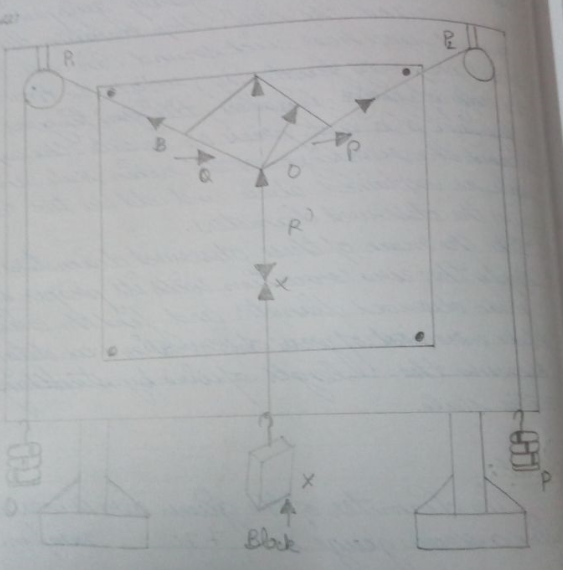
A vertical wooden board with 2 pulleys weight, two hangers, a string for sheets of paper, drawing pins, a strip of mirror, drawing pins, pencil, metre scale, set square, wooden block, protractors, string, thread and a spring balance

Theory:

Law of parallelogram of forces:

When two forces react simultaneously at a point are represented in magnitude and direction by two adjacent sides of a parallelogram, then their resistant is represented both in magnitude and direction by the diagonal of the parallelogram passing through the point of intersecting of two forces.

Procedure:

  1. Clamp the board in vertical position by a plumb line and pin the sheet of paper on it with drawing pins.
  2. The short string in middle of first string to make a knot at 0. Tie the unknown weight at other end. Arrange them on pulleys.
  3. Adjust the weight so that know is in middle of the paper.
  4. When the know comes to rest, mark it on paper.
  5. Repeat the procedure a couple of times.
  6. Remove hangers along with weights and carefully weigh each hanger and slotted weight.
  7. Keep board flat and join the three points to meet at 0. Select a suitable scale and cut lengths OA and OB.
  8. Repeat above set of observation for three more sets of weight.

Sources of Error:-

  • Pulleys may have friction.
  • Weights may not be accurate.
  • Points may not be marked correctly.
  • Weight measured by spring balance may not be much accurate.

Observations:-

Forces Slides Resultant for R (g wt) Unknown weight S(g wt) Weight of Spring (g wt)balance Error (g wt)
P (g wt) Q (g wt) OA (cm) OB (cm)
200 4 200 4 5.9 295 290 5

Diagram:-

Result

– The unknown weight of given body is found to be 290 g.

Viva Questions:-

______ represents the resultant of the vector addition in parallelogram law of vector.

Diagonal of the parallelogram

Friction in the pulleys is one of the sources of error in the experiment using Gravesand’s apparatus. True or False.

False

Mass is a vector quantity. True or False.

False

Define Vector

Physical quantities, having both magnitude and direction are called vector quantities.

Grab other Class XI Physics practicals from here.

To measure the diameter and volume of a given wire using a screw gauge

Grab other Class XI Physics practicals from here.

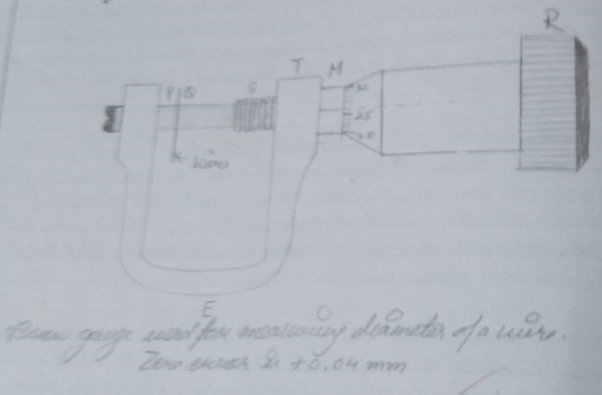
Aim : To measure the diameter and volume of a given wire using a screw gauge.

Apparatus:

Screw gauge, a thin wire and a metre scale

Theory:

Formulae used:

i) Total reading = MSR+CSR
Where MSR = Main scale reading
CSR = Circular scale reading
and, CSR = nxLC
Where n = no of circular scale division coinciding with main scale
LC = Least count of screw gauge
Therefore, total reading = MSR = (nxLC)

ii) If DD be the mean diameter and l be the length of the wire, then volume of wire
V = π(D/2)2l = (πD2l)/4

Procedure:

Measurement of the Diameter

  1. First of all calculate the pitch and the least count of the given screw gauge.
  2. Find the zero error with its proper sign. Even after when the zero error is nil, this fact too should be recorded.
  3. Now insert the wire between the screw and the steed of the screw gauge. Move the screw forward by rotating the ratchet till the wire is gently gripped between the screw and the steed. Stop rotating the ratchet the moment you hear click sound. In case the ratchet is not properly functioning, rotate the circular cap with the help of your fingers, till your fingers start slipping. Do not press or rotate the cap too hard. Record the readings on the main scale and the circular scale as explained above and add the two readings. This gives the observed diameters.
  4. Take the mean of these observed diameters.
  5. Apply the zero correction with its proper sign to the mean observed diameter and find the correct diameter.
  6. Make a record of your observations as detailed below.
  7. Measure the length of wire by stretching it along a metre scale.

Sources of Error:-

  • Backlash error: It occurs due to wear and tear of the screw threads, it is observed that reversing the direction of rotation of the thimble, the tip of the screw does not start moving in the opposite direction immediately, but remains stationary for a part of rotation. This is called back lash error. It occurs if we move the screw in one direction and then in opposite directions repeatedly.
  • Zero error: If on bringing the flat end of the screw in contact with the stud, the zero mark of the circular scale coincides with the zero mark on base line of the main scale, the instrument is said to be free from zero error. Otherwise an error is said to be there.

Observations

:-

Main/Linear Scale Reading (M.S.R.) Circular Scale Reading (C.S.R.) Total observed reading (D) = M.S.R. + (nxLC) (mm)
No of circular scale division in line with main scale (n) n x L.C.(mm)
8 43 0.043 8.043
8 47 0.047 8.047
8 46 0.046 8.046

Length of the wire = 27cm

Calculations

:-

Mean Observed Reading = (8.043+8.047+8.046)/3 = 8.0453 mm

Volume of wire = (πD2l)/4 = π(8.0453/1000)2(0.27)/4 = 0.00001372757m3

Diagram

:-

Result – The diameter of the given wire is measured by using a screw gauge is 8.0453 mm. The volume of the wire is 0.00001372757m3.

Viva Questions:-

What is least count?

The distance through which the screw advances when it is rotated through one division of the head scale.

What is the least count of the screw gauge if the head scale of a screw gauge contains 100 divisions and its pitch is 1 mm?

0.01mm

Screw gauge is less reliable than Vernier calliper in measuring the dimensions of an object. True or False.

False

What is screw gauge commonly referred to as?

Micrometer

What is ratchet’s function in a screw gauge?

Ratchet prevents screw gauge from undue tightening.

Grab other Class XI Physics practicals from here.


Canteen Management – Class XII C++ Project

You can grab other class XII projects from here.

COMPUTER SCIENCE  PROJECT FILE ON CANTEEN MANAGEMENT

TABLE OF CONTENTS

  • Certificate
  • Acknowledgement
  • Working description of project
  • Header files and their purpose
  • Files generated
  • Coding & outputs
  • Bibliography

ACKNOWLEDGEMENT

It would be my utmost pleasure to express my sincere thanks to My Computer Science Teacher Ms. ____________ in providing a helping hand in this project. Her unflagging patience, creativity and immense knowledge that she shared with me have proved highly beneficial to me and have made my Project File both possible and successful.

Name :
Class :

HEADER FILES USED AND THEIR PURPOSE

  1. IOSTREAM.H – for file handling, cin and cout
  2. PROCESS.H – for exit() function
  3. CONIO.H – for clrscr() and getch() functions
  4. STDIO.H – for standard I/O operations
  5. DOS.H – for execution of program
  6. STRING.H – for string handling
  7. IOMANIP.H–for C++ streams I/O manipulators

FILES GENERATED

PROGRAM FILE

CANTEENMANAGEMENT.CPP

OBJECT FILE

CANTEENMANAGEMENT.OBJ

EXECUTION FILE

CANTEENMANAGEMENT.EXE

WORKING DESCRIPTION OF PROJECT

This program is designed to keep the friend’s record.

This program consists of five options as follows

  1. TO PURCHASE
  2. TO SHOW DETAILS
  3. TO ADD NEW CUSTOMER
  4. TO SHOW QUANTITY AVAILABLE
  5. TO EXIT

CODING

/* &&&&&&&&&&&&&&&&&&&&&&&&&&&&&&&&

& COMPUTER SCIENCE PROJECT WORK&

&&&&&&&&&&&&&&&&&&&&&&&&&&&&&&&&

SOFTWARE FOR THE USE OF CANTEEN DEPARTMENT

////INTRODUCTION////

/////////////////////////////

//NAME:-  /

//CLASS:-  /

//ROLL NO.:-  /

/////////////////////////////

####################

#CANTEEN MANAGEMENT#

#################### */

/*## HEADER FILES ##*/

#include<iostream.h>

#include<conio.h>

#include<string.h>

#include<stdio.h>

#include<process.h>

#include<iomanip.h>

#include<dos.h>

main()

{

clrscr();

unsigned int sum,add,d,i,j,e,f,g,h,k,l,w,x,y,z;

unsigned int bir=10,per=36,der=110,mur=8,par=110,cor=90,twr=1199, lur=17,tir=107,

rer=1499;

int qubis=1000,abis=0,qupep=1000,apep=0,quden=110,aden=0,qumun=1000,amun=0,quperk=500,aperk=0,qucoc=400,acoc=0,qutit=100,atit=0,qulux=1000,alux=0,qutid=1000,atid=0,quree=300,aree=0;

unsigned int m=0,n=0,o=0,p=0,q=0,r=0,s=0,t=0,u=0,v=0;

char name[50],rank[10],pu,c[20],a[15],b[15],ok;

clrscr();

printf(“\n +++++++++++++++++++++++++++++++++++++++*++++++++++++++++++++++++++++++++++++++”);

printf(“\n + *** +”);

printf(“\n + ***** +”);

printf(“\n + ******* +”);

printf(“\n + ********* +”);

printf(“\n + *********** +”);

printf(“\n + ************* +”);

printf(“\n + *************** +”);

printf(“\n + ***************** +”);

printf(“\n + ******************* +”);

printf(“\n + ********************* +”);

printf(“\n + *********************** +”);

printf(“\n + ************************* +”);

printf(“\n + *************************** +”);

printf(“\n + ***************************** +”);

printf(“\n + ******************************* +”);

printf(“\n + ********************************* +”);

printf(“\n + *********************************** +”);

printf(“\n + ************************************* +”);

printf(“\n + *************************************** +”);

printf(“\n + ***************************************** +”);

printf(“\n + ******************************************* +”);

printf(“\n + ********************************************* +”);

printf(“\n + *********************************************** +”);

printf(“\n + ************************************************* +”);

printf(“\n + *********************WELCOME*********************** +”);

printf(“\n + ************************************************* +”);

printf(“\n + *********************************************** +”);

printf(“\n + ********************************************* +”);

printf(“\n + ******************************************* +”);

printf(“\n + *************************************** +”);

printf(“\n + ************************************* +”);

printf(“\n + *********************************** +”);

printf(“\n + ********************************* +”);

printf(“\n + ******************************* +”);

printf(“\n + ***************************** +”);

printf(“\n + *************************** +”);

printf(“\n + ************************* +”);

printf(“\n + *********************** +”);

printf(“\n + ********************* +”);

printf(“\n + ******************* +”);

printf(“\n + ***************** +”);

printf(“\n + *************** +”);

printf(“\n + ************* +”);

printf(“\n + *********** +”);

printf(“\n + ********* +”);

printf(“\n + ******* +”);

printf(“\n + ***** +”);

printf(“\n + *** +”);

printf(“\n +++++++++++++++++++++++++++++++++++++++*++++++++++++++++++++++++++++++++++++++”);

getch();

clrscr();

cout<<“\n\n\t w w e e e e e e e e l “;

cout<<“\n\n\t w w w e l “;

cout<<“\n\n\t w w w w e l “;

cout<<“\n\n\t w w w w e e e e e e e e l “;

cout<<“\n\n\t w w w w e e e e e e e e l “;

cout<<“\n\n\t w w w w e l “;

cout<<“\n\n\t w w w w e l “;

cout<<“\n\n\t w w e e e e e e e e l l l l l l l l”;

cout<<“\n\n\n\n c c c c c c c o o o o o o o m m e e e e e e e e “;

cout<<“\n\n c o o m m m m e “;

cout<<“\n\n c o o m m m m e “;

cout<<“\n\n c o o m m m m e e e e e e e e “;

cout<<“\n\n c o o m m m m e e e e e e e e “;

cout<<“\n\n c o o m m m m e “;

cout<<“\n\n c o o m m m m e “;

cout<<“\n\n c c c c c c c o o o o o o o m m m e e e e e e e e “;

getch();

clrscr();

main:;

cout<<“\n\n\n\t\t\t AFFWA CANTEEN MANAGEMENT”;

cout<<“\n\n\nCONSUMER INFORMATION”;

cout<<“\n\n\n\n NAME:”;

gets(name);

cout<<“\n RANK:”;

gets(rank);

cout<<“\n SERVICE NO.:”;

cin>>a;

cout<<“\n SMART CARD NO.:”;

cin>>b;

cout<<“\n PHONE NO.:”;

cin>>c;

cout<<“\n ENTER BILL NO.:”;

cin>>i;

again:;

clrscr();

cout<<“\n\n\n\n\1.MENU & PURCHASE”;

cout<<“\n\n\n\2.DETAILS”;

cout<<“\n\n\n\3.NEW CUSTOMER”;

cout<<“\n\n\n\4.QUANTITY AVAILABLE”;

cout<<“\n\n\n\5.EXIT”;

cout<<“\n\n\nENTER YOUR CHOICE:”;

cin>>d;

clrscr();

switch(d)

{

case 1:

cout<<“\nITEMS\t\t\t\t\t\t\t RATE(RS)”;

cout<<“\n\n\nBISCUTE\t\t\t\t\t\t\t\t10 “;

cout<<“\n\nPEPSODENT\t\t\t\t\t\t\t36”;

cout<<“\n\nDENIM POWDER\t\t\t\t\t\t\t110 “;

cout<<“\n\nMUNCH\t\t\t\t\t\t\t\t8 “;

cout<<“\n\nPARK AVENUE PERFUME\t\t\t\t\t\t110 “;

cout<<“\n\nCOCONUT HAIR OIL\t\t\t\t\t\t90 “;

cout<<“\n\nTITAN WATCH\t\t\t\t\t\t\t1199 “;

cout<<“\n\nLUX SOAP\t\t\t\t\t\t\t17 “;

cout<<“\n\nTIDE\t\t\t\t\t\t\t\t107 “;

cout<<“\n\nREEBOK SHOES\t\t\t\t\t\t\t1499 “;

start:

cout<<“\n\n\nDO YOU WANT TO PURCHASE(Y/N):\n”;

cin>>pu;

if(pu==’Y’||pu==’y’)

{switch(pu)

case 1:

clrscr();

cout<<“\n\n\n\t\t\t\tPURCHASE LIST”;

bis:;

cout<<“\nBISCUTE(MAX 30): “;

cin>>m;

if(m>30)

{

cout<<“Enter Quantity Smaller than 30”;

getch();

goto bis;

}

else

abis=qubis-m;

pep:;

cout<<“\nPEPSODENT(MAX 2): “;

cin>>n;

if(n>2)

{

cout<<“Enter Quantity Smaller than 2”;

getch();

goto pep;

}

else

apep=qupep-n;

den:;

cout<<“\nDENIM POWDER(MAX 2): “;

cin>>o;

if(o>2)

{

cout<<“Enter Quantity Smaller then 2”;

getch();

goto den;

}

else

aden=quden-o;

mun:;

cout<<“\nMUNCH(MAX 50): “;

cin>>p;

if(p>50)

{

cout<<“Enter Quantity Smaller then 50”;

getch();

goto mun;

}

else

amun=qumun-p;

park:;

cout<<“\nPARK AVENUE PERFUME(MAX 2): “;

cin>>q;

if(q>2)

{

cout<<“Enter Quantity Smaller then 2”;

getch();

goto park;

}

else

aperk=quperk-q;

coco:;

cout<<“\nCOCONUT HAIR OIL(MAX 2): “;

cin>>r;

if(r>2)

{

cout<<“Enter Quantity Smaller then 2”;

getch();

goto coco;

}

else

acoc=qucoc-r;

titan:;

cout<<“\nTITAN WATCH(MAX 2): “;

cin>>s;

if(s>2)

{

cout<<“Enter Quantity Smaller then 2”;

getch();

goto titan;

}

else

atit=qutit-s;

lux:;

cout<<“\nLUX SOAP(MAX 10): “;

cin>>t;

if(t>10)

{

cout<<“Enter Quantity Smaller then 10”;

getch();

goto lux;

}

else

alux=qulux-t;

tid:;

cout<<“\nTIDE(MAX 2): “;

cin>>u;

if(u>2)

{

cout<<“Enter Quantity Smaller then 2”;

getch();

goto tid;

}

else

atid=qutid-u;

ree:;

cout<<“\nREEBOK SHOES(MAX 4): “;

cin>>v;

if(v>4)

{

cout<<“Enter Quantity Smaller then 4”;

getch();

goto ree;

}

else

aree=quree-v;

cout<<“\n”;

clrscr();

cout<<“\n\n\n\n\n\n\t\t\t\tAFFWA CANTEEN\n”;

cout<<“\n\n\t\t\t\t CASH MEMO\n”;

cout<<“\n\nBILL NO.:”<<i;

cout<<“\n\nNAME:”;

cout<<name;

cout<<“\n\nRANK:”<<rank;

cout<<“\n\nSERVICE NO.:”<<a;

cout<<“\n\nSMART CARD NO.:”<<b;

cout<<“\n\nPHONE NO.:”<<c;

cout<<“\n\n\n\n\n”;

cout<<“===============================================================================”;

cout<<“\nITEMS” <<setw(40)<<“QUANTITY”<<setw(35)<<“PRICE(Rs.)”;

cout<<“===============================================================================”;

if(m>0)

cout<<“\n\nBISCUTE” <<setw(38)<<m<<setw(28)<<“Rs.”<<m*bir;

if(n>0)

cout<<“\n\nPEPSODENT” <<setw(36)<<n<<setw(28)<<“Rs.”<<n*per;

if(o>0)

cout<<“\n\nDENIM POWDER” <<setw(33)<<o<<setw(28)<<“Rs.”<<o*der;

if(p>0)

cout<<“\n\nMUNCH” <<setw(40)<<p<<setw(28)<<“Rs.”<<p*mur;

if(q>0)

cout<<“\n\nPARK AVENUE PERFUME”<<setw(26)<<q<<setw(28)<<“Rs.”<<q*par;

if(r>0)

cout<<“\n\nCOCONUT HAIR OIL” <<setw(29)<<r<<setw(28)<<“Rs.”<<r*cor;

if(s>0)

cout<<“\n\nTITAN WATCH” <<setw(34)<<s<<setw(28)<<“Rs.”<<s*twr;

if(t>0)

cout<<“\n\nLUX SOAP” <<setw(37)<<t<<setw(28)<<“Rs.”<<t*lur;

if(u>0)

cout<<“\n\nTIDE” <<setw(41)<<u<<setw(28)<<“Rs.”<<u*tir;

if(v>0)

cout<<“\n\nREEBOK SHOES” <<setw(33)<<v<<setw(28)<<“Rs.”<<v*rer;

e=m*bir;

f=n*per;

g=o*der;

h=p*mur;

k=q*par;

l=r*cor;

w=s*twr;

x=t*lur;

y=u*tir;

z=v*rer;

sum=e+f+g+h+k+l+w+x+y+z;

add=m+n+o+p+q+r+s+t+u+v;

cout<<“\n===============================================================================”;

cout<<“\nTOTAL:”<<setw(40)<<add<<setw(27)<<“Rs.”<<sum;

cout<<“\n\nTHANK YOU .\t\t\t VISIT US AGAIN\n”;

getch();

clrscr();

goto again;

}

else

{goto again;

}

case 2:

cout<<“\n\n\n\n\n\t\t\t\tCANTEEN DETAILS”;

cout<<“\n\n#TIMING:\n\n 11 AM TO 02 PM \n 03 PM TO 05 PM”;

cout<<“\n\n#CANTEEN WILL CLOSED ON TUESDAY”;

cout<<“\n\n#GOODS ONCE SOLD WILL NOT BE EXCHANGED/REPLACED”;

cout<<“\n\n#TAKE YOUR SMART CARD WITH YOU”;

cout<<“\n\n#COLLECT YOUR SMART CARD & BILL AFTER PAYMENT”;

cout<<“\n\n#DO NOT BREAK ANY CANTEEN ITEMS”;

getch();

clrscr();

goto again;

case 3:

goto main;

case 4:

if(m>0||n>0||o>0||p>0||q>0||r>0||s>0||t>0||u>0||v>0)

{cout<<“\n\t\t\tItems Avaliable in Canteen.\n\n\n”;

cout<<“===============================================================================”;

cout<<“\nITEMS” <<setw(40)<<“QUANTITY”;

cout<<“\n===============================================================================”;

cout<<“\n\n\nBISCUTE” <<setw(38)<<abis;

cout<<“\n\n\nPEPSODENT” <<setw(36)<<apep;

cout<<“\n\n\nDENIM POWDER” <<setw(33)<<aden;

cout<<“\n\n\nMUNCH” <<setw(40)<<amun;

cout<<“\n\n\nPARK AVENUE PERFUME”<<setw(26)<<aperk;

cout<<“\n\n\nCOCONUT HAIR OIL” <<setw(29)<<acoc;

cout<<“\n\n\nTITAN WATCH” <<setw(34)<<atit;

cout<<“\n\n\nLUX SOAP” <<setw(37)<<alux;

cout<<“\n\n\nTIDE” <<setw(41)<<atid;

cout<<“\n\n\nREEBOK SHOES” <<setw(33)<<aree;

cout<<“\n*******************************************************************************”;

getch();

goto again;

}

else

{{cout<<“\n\t\t\tItems Avaliable in Canteen.\n\n\n”;

cout<<“===============================================================================”;

cout<<“\nITEMS” <<setw(40)<<“QUANTITY”;

cout<<“\n===============================================================================”;

cout<<“\n\n\nBISCUTE” <<setw(38)<<qubis;

cout<<“\n\n\nPEPSODENT” <<setw(36)<<qupep;

cout<<“\n\n\nDENIM POWDER” <<setw(33)<<quden;

cout<<“\n\n\nMUNCH” <<setw(40)<<qumun;

cout<<“\n\n\nPARK AVENUE PERFUME”<<setw(26)<<quperk;

cout<<“\n\n\nCOCONUT HAIR OIL” <<setw(29)<<qucoc;

cout<<“\n\n\nTITAN WATCH” <<setw(34)<<qutit;

cout<<“\n\n\nLUX SOAP” <<setw(37)<<qulux;

cout<<“\n\n\nTIDE” <<setw(41)<<qutid;

cout<<“\n\n\nREEBOK SHOES” <<setw(33)<<quree;

cout<<“\n\n*******************************************************************************”;

getch();

goto again;

}

case 5:

cout<<“\n\n\n\n\n\n\n\n\n\t\t\t\t THANKS”;

sleep(1);

clrscr();

cout<<“\n\n\n\n\n\n\n\n\n\n\n\n\n\n\t\t\t\t THANKS”;

sleep(1);

clrscr();

cout<<“\n\n\n\n\n\n\n\n\n\n\n\n\n\n\n\n\n\n\n\n\t\t\t\t THANKS”;

sleep(1);

clrscr();

cout<<“\n\n\n\n\n\n\n\n\n\n\n\n\n\n\n\n\n\n\n\n\n\n\n\n\t\t\t\t THANKS”;

sleep(1);

clrscr();

cout<<“\n\n\n\n\n\n\n\n\n\n\n\n\n\n\n\n\n\n\n\n\n\n\n\n\n\n\n\n\t\t\t\t THANKS”;

sleep(1);

clrscr();

cout<<“\n\n\n\n\n\n\n\n\n\n\n\n\n\n\n\n\n\n\n\n\n\n\n\n\n\n\n\n\n\n\n\n\t\t\t\t THANKS”;

sleep(1);

clrscr();

cout<<“\n\n\n\n\n\n\n\n\n\n\n\n\n\n\n\n\n\n\n\n\n\n\n\n\n\n\n\n\n\n\n\n\n\n\n\n\t\t\t\t THANKS”;

sleep(1);

clrscr();

cout<<“\n\n\n\n\n\n\n\n\n\n\n\n\n\n\n\n\n\n\n\n\n\n\n\n\n\n\n\n\n\n\n\n\n\n\n\n\n\n\n\t\t\t\t THANKS”;

sleep(1);

clrscr();

cout<<“\n\n\n\n\n\n\n\n\n\n\n\n\n\n\n\n\n\n\n\n\n\n\n\n\n\n\n\n\n\n\n\n\n\n\n\n\n\n\n\n\n\n\t\t\t\t THANKS\n\n\n\t\t\t\tPress any key to Exit…….”;

getch();

exit(0);

default:

cout<<“Your choice is wrong”;

getch();

goto again;

}

//getch();

// return 0;

}}

OUTPUTS

BIBLIOGRAPHY

COMPUTER SCIENCE IN C++ BY :– SUMITA ARORA

You can grab other class XII projects from here.

Drawing I-V characteristics graph of p-n junction diode in forward biasing and to find state and dynamic resistance.

You can also get Class XII Practicals on BiologyPhysics, and Physical Education.

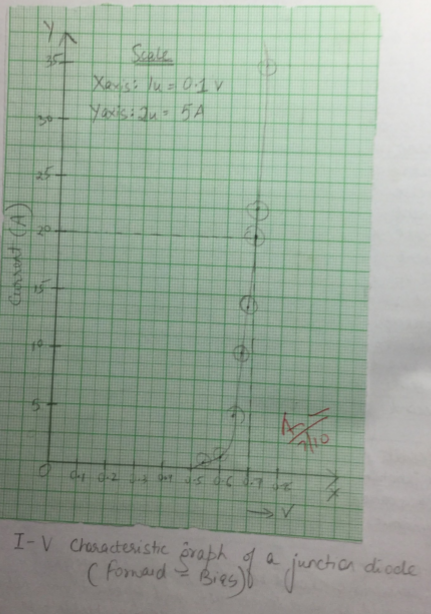
Aim : To draw I-V characteristics graph of p-n junction diode in forward biasing and to find state and dynamic resistance.

Apparatus : A p-n junction (semi conductor) diode, a 3 volt battery, a 50 volt battery, a high resistance rheostat, one 0-3 volt voltmeter, one 0-50 volt voltmeter, one 0-100 mA ammeter, a 0-100 uA ammeter, one way key, connecting wires & sand paper.

Theory :

When the p section of the diode is connected to positive terminal and of a battery and n section is connected to negative terminal of the battery then junction is said to be forward bias with an increase in bias voltage the forward current increases slowly in the beginning and then rapidly. At about 0.7 V for SI diode (0.1 V for Ge), the current increase suddenly. The value of forward bias voltage, at which the forward current increases rapidly, is called cut in voltage or threshold voltage.

Procedure

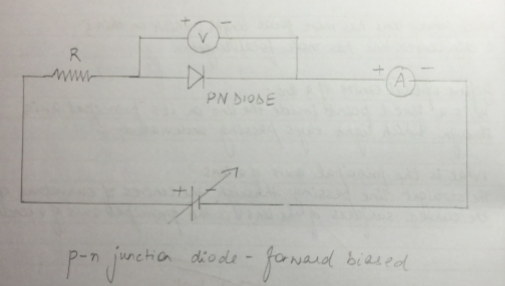
  • Make circuit as shown in the circuit diagram.
  • Make all the connection neat and tight.
  • Note at least count and zero error of voltmeter (V) and milliammeter (mA)
  • Bring moving contact of the potential divider (rheostat) near the negative end. Insert the key K. Voltmeter V and milliammeter mA will give zero reading.
  • Move the contact a little towards the positive end to apply a forward bias voltage (vF) of 0.1 V current remains zero.
  • Increase the forward bias voltage up to 0.3 V for Ge diode.
  • Current remains zero ( it is due to junction potential barrier of 0.3 V)
  • Increase VF to 0.4 V Milli ammeter records a small current.
  • Increase Vf in steps to 0.2 V and note the corresponding current. Current increase first slowly and then rapidly till Vf becomes 0.7 V.
  • Make VE = 0.72 V. The current increases suddenly. This represents “ forward breakdown” stage.
  • If the VF increases beyond the “ forward breakdown” stage the forward current doesn’t change much. Now take out the key at once.
  • Record your observation.

Result

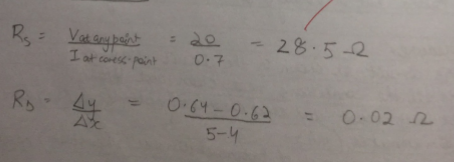
This junction resistance for forward bias :

Resistance (static ) = 28.5 ohm.

Dynamic resistance = 0.02 ohm.

Precaution

  • All connection should be neat and tight.
  • Key should be used in circuit and opened when not in use.
  • Forward bias voltage beyond breakdown shouldn’t be applied.

Sources of error

The junction diode applied may be faulty.

Circuit diagram

P-N Junction Diode Forward Biased

IV Characteristic graph of junction diode

Observation Table

S No Potential diff across diode (v) Current (A)
1 0.1 0
2 0.2 0
3 0.3 0
4 0.4 0
5 0.5 0
6 0.54 1
7 0.6 2
8 0.62 4
9 0.64 5
10 0.66 10
11 0.68 13
12 0.7 20
13 0.7 25
14 0.72 30
15 0.72 35

Calculation

Calculation for IV Junction Diode


Viva question

What is a function ?

It is a common surface of n type and p type semiconductor.

What is junction potential barrier ?

The potential difference between junction ends of the two types of semi conductor is called junction potential barrier.

What are the two types of biasing ?

1 forward biasing 2 Reverse biasing

Why is a forward bias so called ? How does it affect junction resistance ?

Forward bias so called because it makes free charge carrier to move forward towards junction . It increases the junction resistance (make less).

You can also get Class XII Practicals on BiologyPhysics, and Physical Education.