
Grab other Class XI Physics practicals from here.
Aim : To measure the diameter and volume of a given wire using a screw gauge.
Apparatus:
Screw gauge, a thin wire and a metre scale
Theory:
Formulae used:
i) Total reading = MSR+CSR
Where MSR = Main scale reading
CSR = Circular scale reading
and, CSR = nxLC
Where n = no of circular scale division coinciding with main scale
LC = Least count of screw gauge
Therefore, total reading = MSR = (nxLC)
ii) If DD be the mean diameter and l be the length of the wire, then volume of wire
V = π(D/2)2l = (πD2l)/4
Procedure:
Measurement of the Diameter
- First of all calculate the pitch and the least count of the given screw gauge.
- Find the zero error with its proper sign. Even after when the zero error is nil, this fact too should be recorded.
- Now insert the wire between the screw and the steed of the screw gauge. Move the screw forward by rotating the ratchet till the wire is gently gripped between the screw and the steed. Stop rotating the ratchet the moment you hear click sound. In case the ratchet is not properly functioning, rotate the circular cap with the help of your fingers, till your fingers start slipping. Do not press or rotate the cap too hard. Record the readings on the main scale and the circular scale as explained above and add the two readings. This gives the observed diameters.
- Take the mean of these observed diameters.
- Apply the zero correction with its proper sign to the mean observed diameter and find the correct diameter.
- Make a record of your observations as detailed below.
- Measure the length of wire by stretching it along a metre scale.
Sources of Error:-
- Backlash error: It occurs due to wear and tear of the screw threads, it is observed that reversing the direction of rotation of the thimble, the tip of the screw does not start moving in the opposite direction immediately, but remains stationary for a part of rotation. This is called back lash error. It occurs if we move the screw in one direction and then in opposite directions repeatedly.
- Zero error: If on bringing the flat end of the screw in contact with the stud, the zero mark of the circular scale coincides with the zero mark on base line of the main scale, the instrument is said to be free from zero error. Otherwise an error is said to be there.
Observations
:-
| Main/Linear Scale Reading (M.S.R.) | Circular Scale Reading (C.S.R.) | Total observed reading (D) = M.S.R. + (nxLC) (mm) | |
| No of circular scale division in line with main scale (n) | n x L.C.(mm) | ||
| 8 | 43 | 0.043 | 8.043 |
| 8 | 47 | 0.047 | 8.047 |
| 8 | 46 | 0.046 | 8.046 |
Length of the wire = 27cm
Calculations
:-
Mean Observed Reading = (8.043+8.047+8.046)/3 = 8.0453 mm
Volume of wire = (πD2l)/4 = π(8.0453/1000)2(0.27)/4 = 0.00001372757m3
Diagram
:-
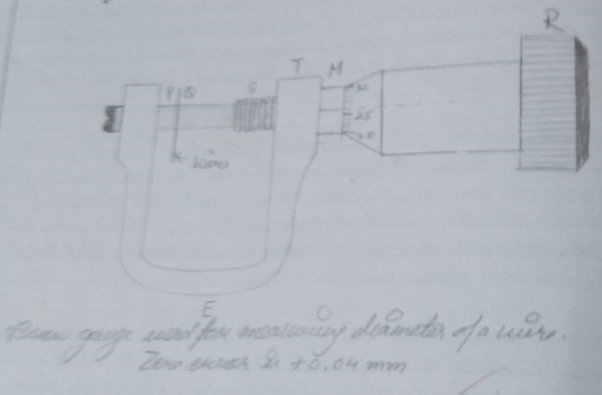
Result – The diameter of the given wire is measured by using a screw gauge is 8.0453 mm. The volume of the wire is 0.00001372757m3.
Viva Questions:-
What is least count?
The distance through which the screw advances when it is rotated through one division of the head scale.
What is the least count of the screw gauge if the head scale of a screw gauge contains 100 divisions and its pitch is 1 mm?
0.01mm
Screw gauge is less reliable than Vernier calliper in measuring the dimensions of an object. True or False.
False
What is screw gauge commonly referred to as?
Micrometer
What is ratchet’s function in a screw gauge?
Ratchet prevents screw gauge from undue tightening.
Grab other Class XI Physics practicals from here.

It’s fine but not so helpful because it doesn’t contain precautions of the experiment.
I have a question plz give answer how is l is taken in the formula
so helpful to recall the experiment.
bro where is discussion
It doesn’t have the measurement of wire in perpendicular direction
Plz any one reply fast..
Why.
Worst note 😠😡😖😠😠😡😡😡
Where’s the formula for zero correction?
It is nice quite helpful 🤔😄
Very useful
इसकी सावधानियां क्या क्या हैं
Very very helpful.. Thanks a lot for notes😊
Its a good notes
Very helpful notes.thank you😊