Constituents Of An Alloy – Chemistry Project


S.No. Contents II Page No.
I. Introduction 4
II. Material Required 5
III. Theory 6
IV. Procedure 8
V. Conclusion 10
VI. Bibliography 10

Introduction

An alloy is a homogeneous mixture of two or more metals or a metal and non-metal.

They are generally harder than their components with reduced malleability and ductility. Alloys are prepared to enhance certain characteristics of the constituent metals, as per requirement.

In this project, we shall qualitatively analyze the chemical composition of two alloys:

MATERIALS REQUIRED

1) BRASS AND BRONZE PIECES

2) CHINA DISHES

3) FILTRATION APPARATUS

4) NITRIC ACID

5) HYDROGEN SULPHIDE GAS

7) AMMONIUM CHLORIDE

8)POTASSIUM FERROCYANIIDE

9) AMMONIUM SULPHIDE

10) DIL HYDROCHLORIC ACID

Theory

Brass

Brass contains Cu and Zn . Both dissolve in nitric acid.

4Zn+ 10 HNO3 –> 4Zn(NO)2+ N2O + 5HO

3Cu + 8 HNO3 –> 3Cu(NO3)2 + 4HO+2NO

Further analysis is carried out for respective ions.

Cu dissolves in H2S to give black ppt. of CuS. It is filtered to get the soln of Zinc Sulphide. It precipitates out in the form of ZnCl2 in an ammonical soln. of Ammonium chloride. The precipitate is dissolved in dilute HCl and then treated with Potassium ferrocyanide to get a bluish-white ppt. of Zn2[Fe(CN)6].

Bronze

Bronze contains Cu and Sn. Their nitrates are obtained by dissolving the sample in conc. Nitric acid. The nitrates are precipitated as sulphides by passing H2S through their solution in dil. HCl.

The CuS is insoluble in yellow ammonium sulphide, while SnS is soluble. The ppt. is separated by filtration.

The ppt. is dissolved in cone HNO3 and then Ammonium hydroxide solution is passed through it. Blue colouration confirms the presence of Cu.

The filtrate is treated with conc. HCl followed by Zinc dust to obtain SnCl2 . Then HgCl2 solution is added. Formation of slate-coloured ppt. indicates the presence of Sn.

Procedure

Brass:

1. A small piece of brass was placed in a china dish and dissolved in minimum quantity of 50% conc. H2SO4.

2. The soln. was heated to obtain a dry residue. The residue was dissolved in Dilute HCl gas was passed and a black.ppt. was observed. The soln. was filtered and the ppt. was dissolved in NH4OH soln. A blue coloration observed indicates the presence of Cu.

4.   The filtrate was tested for presence of Zn. Ammonium hydroxide and chloride solutions were added and then H2S gas was passed. A dull grey ppt. was separated and dissolved in dil. HCl. followed by addition of Potassium ferrocyanide. A bluish white ppt. confirms the presence of Zn.

Bronze:

1. The sample was dissolved in 50% HNO3 and then heated to obtain nitrates.

2. The nitrates were dissolved in dil. HCl and then precipitated as sulphides by passing H2S gas.

3. The precipitates were treated with yellow amm.sulphide.

4. The ppt. was tested for Cu as in the case of brass.

5. The filtrate was treated with conc. HCl followed by Fe dust.

6. Then HgCl2 soln. was added. Formation of a slate-coloured ppt. confirmed the presence of Sn.

Conclusion

Brass contains Copper and

Bronze contains Copper and Tin.

Bibliography

1. Comprehensive practical Chemistry- Class 12.

2. www.alloyanalyzer.niit.edu

You can find other Chemistry Projects here.

Compare Rate Of Fermentation Of Wheat Flour – Chemistry Project


S.No. Contents II Page No.
I. Objective 4
II. Introduction 5
III. Theory 7
IV. Material required 8
V. Procedure 9
VI. Observation 11
VII. Bibliography 11

OBJECTIVE

The purpose of the experiment is – to compare the rate of fermentation of the given samples of wheat flour, gram flour, rice flour and potatoes.

I became interested in this idea when I saw some experiments on fermentation and wanted to find out some scientific facts about fermentation. The primary benefit of fermentation is the conversion of sugars and other carbohydrates ,e.g., converting juice into wine, grains into beer, carbohydrates into carbon dioxide to leaven bread, and sugars in vegetables into preservative organic acids.

INTRODUCTION

Fermentation typically is the conversion of carbohydrates to alcohols and carbon dioxide or organic acids using yeasts, bacteria, or a combination thereof, under anaerobic conditions. A more restricted definition of fermentation is the chemical conversion of sugars into ethanol. The science of fermentation is known as zymology. Fermentation usually implies that the action of microorganisms is desirable, and the process is used to produce alcoholic beverages such as wine, beer, and cider. Fermentation is also employed in preservation techniques to create lactic acid in sour foods such as sauerkraut, dry sausages, and yoghurt, or vinegar for use in pickling foods.

Fermentation in food processing typically is the conversion of carbohydrates to alcohols and carbon dioxide or organic acids using yeasts, bacteria or a combination thereof, under anaerobic conditions. A more restricted definition of fermentation is the chemical conversion of sugars into ethanol. The science of fermentation is known as zymology.

Fermentation usually implies that the action of microorganisms is desirable, and the process is used to produce alcoholic beverages such as wine , beer, and cider. Fermentation is also employed in preservation techniques to create lactic acid in sour foods such as sauerkraut , dry sausages,  and yogurt, or vinegar (acetic acid) for use in pickling foods.

Uses

Food fermentation has been said to serve five main purposes:

#  Enrichment of the diet through development of a diversity of flavours, aromas, and textures in food substrates

#  Preservation of substantial amounts of food through lactic acid, alcohol, acetic acid and alkaline fermentations

#  Biological enrichment of food substrates with protein, essential amino acids, essential fatty acids, and vitamins

#  Elimination of ant nutrients.

#  A decrease in cooking times and fuel requirements

Theory

Wheat flour, gram flour, rice flour and potatoes contains starch as the major constituent. Starch present in these food materials is first brought into solution. In the presence of enzyme diastase, starch undergoes fermentation to give maltose.

Starch gives blue-violet colour with iodine whereas product of fermentation starch do not give any characteristic colour. When the fermentation is complete the reaction mixture stops giving blue-violet colour with iodine solution.

By comparing the time required for completion of fermentation of equal amounts of different substances containing starch the rates of fermentation can be compared. The enzyme diastase is obtained by germination of moist barley seeds in dark at 15 degree celsius. When the germination is complete the temperature is raised to 60 degree celsius to stop further growth. The seeds are crushed into water and filtered. The filtrate contains enzyme diastase and is called malt extract.

MATERIALS REQUIRED

#   Conical flask

#   Test tube

#   Funnel

#   Filter paper

#   Water bath

#   1 % Iodine solution

#   Yeast

#   Wheat flour

#   Gram flour

#   Rice flour

#   Potato

#   Aqueuos NaCl solution

PROCEDURE

#   Take 5 gms of wheat flour in 100 ml conical flask and add 30 ml of distilled water.

#   Boil the contents of the flask for about 5 minutes

#   Filter the above contents after cooling, the filtrate obtained is wheat flour extract.

#   To the wheat flour extract. taken in a conical flask.

Add 5 ml of 1% aq. NaCl solution.

#    Keep this flask in a water bath maintained at a temperature of 50-60 degree celsius. Add 2 ml  of malt extract.

#   After 2 minutes take 2 drops of the reaction mixture and add to diluted iodine solution.

#   Repeat step 6 after every 2 minutes. When no bluish colour is produced the fermentation is complete.

#   Record the total time taken for completion of fermentation.

#   Repeat the experiment with gram flour extract, rice flour extract, potato extract and record the observations

OBSERVATIONS

Time required for the fermentation—

# Wheat flour — 10 hours

#  Gram flour –  12.5 hours

#  Rice flour — 15 hours

#  Potato — 13 hours

BIBLIOGRAPHY

#   Chemistry manual

You can find other Chemistry Projects here.

Commercial Antacid – Chemistry Project


S.No. Contents II Page No.
I. Introduction 4
II. Requirements 6
III. Procedure 7
IV. Observation 10
V. Conclusion 13
VI. Bibliography 13

INTRODUCTION

An Antacid is any substance, generally a base or basic salt, which neutralizes stomach acidity. They are used to relieve acid indigestion, upset stomach, sour stomach, and heartburn.

ACTION MECHANISM

Antacids perform a neutralization reaction, i.e. they buffer gastric acid, raising the pH to reduce acidity in the stomach. When gastric hydrochloric acid reaches the nerves in the gastrointestinal mucosa, they signal pain to the central nervous system. This happens when these nerves are exposed, as in peptic ulcers. The gastric acid may also reach ulcers in the oesophagus or the duodenum.

Other mechanisms may contribute, such as the effect of aluminium ions inhibiting smooth muscle cell contraction and delaying gastric emptying.

INDICATIONS

Antacids are taken by mouth to relieve heartburn, the major symptom of gastro oesophageal reflux disease, or acid indigestion. Treatment with antacids alone is symptomatic and only justified for minor symptoms. Peptic ulcers may require H2-receptor antagonists or proton pump inhibitors.

The utility of many combinations of antacids is not clear, although the combination of magnesium and aluminium salts may prevent alteration of bowel habits.

INTERACTIONS

Altered pH or complex formation may alter the bioavailability of other drugs, such as tetracycline. Urinary excretion of certain drugs may also be affected.

PROBLEMS WITH REDUCED STOMACH ACIDITY

Reduced stomach acidity may result in an impaired ability to digest and absorb certain nutrients, such as iron and the B vitamins. Since the low pH of the stomach normally kills ingested bacteria, antacids increase the vulnerability to infection. It could also result in reduced bioavailability of some drugs. For example, the bioavailability of ketoconazole (antifungal) is reduced at high intragastric pH (low acid content).

SOME FAMOUS ANTACID BRANDS

1. Alka-Seltzer – NaHCO3 and/or KHCO3

2. Equate – Al(OH)3 and Mg(OH)2

3. Gaviscon – Al(OH)3

4. Maalox (liquid) – Al(OH)3 and Mg(OH)2

5. Maalox (tablet) – CaCO3

6. Milk of Magnesia – Mg(OH)2

7. Pepto-Bismol – HOC6H4COO

8. Pepto-Bismol Children’s – CaCO3

9. Rolaids – CaCO3 and Mg(OH)2

10. Tums – CaCO3

11. Mylanta

DRUG NAMES

Some drugs used as antacids are :

1. Aluminium hydroxide

2. Magnesium hydroxide

3. Calcium carbonate

4. Sodium bicarbonate

5. Bismuth subsalicylate

6. Histamine

7. Cimetidine

8. Ranitidine

9. Omeprazole

10. Lansoprazole

REQUIREMENTS :

  • Burettes
  • Pipettes
  • Titration flasks
  • Measuring flasks
  • Beakers
  • Weight box
  • Fractional weights
  • Sodium hydroxide
  • Sodium carbonate
  • Hydrochloric acid
  • Phenolphthalein.

PROCEDURE :

1. Prepare 1 litre of approximately  HCl solution by diluting 10 ml of the concentrated acid for one litre.

2. Similarly, make 1 litre of approximately NaOH solution by dissolving4.0g of NaOH to prepare one litre of solution.

3. Prepare  Na2CO3 solution by weighing exactly 1.325 g of anhydrous sodium carbonate and then dissolving it in water to prepare exactly 0.25 litres (250 ml) of solution.

4. Standardize the HCl solution by titrating it against the standard Na2CO3 solution using methyl orange as indicator.

5. Similarly, standardize NaOH solution by titrating it against standardized HCl solution using phenolphthalein as indicator.

6. Powder the various samples of antacid tablets and weigh 1.0 g of each.

7. Add a specific volume of standardised HCl to each of the weighed sample is taken in conical flasks. The acid should be in slight excess, so that it can neutralize all the alkaline component of the tablet.

8. Add 2 drops of phenolphthalein and warm the flask till most of powder dissolves. Filter off the insoluble material.

9. Titrate this solution against the standardised NaOH solution, till a permanent pinkish tinge is obtained. Repeat this experiment with different antacids.

OBSERVATIONS:

Standardisation of HCl solution :

Volume of Na2CO3 solution taken = 20.0 ml

S No. of obs. Burette readings

Initial       Final

Volume of acid used
1.

2.

3.

4.

5.

0 ml          15.0 ml

0 ml          15.1 ml

0 ml          15.0 ml

0 ml          15.0 ml

0 ml          15.0ml

15.0 ml

15.1 ml

15.0 ml

15.0 ml

15.0 ml

Concordant volume = 15.0 ml

Applying normality equation,

N1V1 = N2V2

N1 * 15.0 =  * 20

Normality of HCl, N1 = = 0.133 N

Standardisation of NaOH solution :

Volume of the given NaOH solution taken = 20.0 ml

S No. of obs. Burette readings

 Initial     Final


Volume of acid used
1.

2.

3.

4.

5.

0 ml          26.5 ml

0 ml          26.8 ml

0 ml          26.6 ml

0 ml          26.6 ml

0 ml          26.6ml

26.5 ml

26.8 ml

26.6 ml

26.6 ml

26.6 ml

Concordant volume = 26.6 ml

Applying normality equation,

N1V1 = N2V2

0.133 x26.6 = N2x20

Normality of NaOH = = 0.176 N

Analysis of antacid tablet :

Weight of antacid tablet powder = 1.0 g

Volume of HCl solution added = 20.0 ml

Antacid Vol. Of NaOH soln. Used to neutralise unused HCl Vol. Of HCl soln. Used to neutralise 1.0 g of antacid matter
1. Gelusil

2. Digene

3. Aludrox

4. Logas

5. Ranitidine

6. Ocid 20

12.1 ml

16.0 ml

19.3 ml

24.3 ml

21.4 ml

22.7 ml

12.0 ml

16.2 ml

18.9 ml

24.4 ml

21.7 ml

21.9 ml

CONCLUSION :

The antacid which has maximum volume of HCl is used for neutralizing i.e. Ocid 20 is more effective.

BIBLIOGRAPHY

1. WEBSITES :

  • www.pharmaceutical-drugmanufacturers.com

2. BOOKS :

  • Comprehensive Practical Manual for class XII
  • Pradeep’s New Course Chemistry
  • NCERT Class XII Part II

You can find other Chemistry Projects here.

Analysis Of Different Brands Of Cold Drinks – Chemistry Project


S.No. Contents II Page No.
I. Introduction 4
II. Theory 5
III. Apparatus 6
IV. Detection of pH 9
V. Test for Carbon Dioxide 10
VI. Test for Glucose 11
VII. Test for Alcohol 13
VIII. Test for Sucrose 15
IX. Result 17
X. Conclusion 18
XI. Bibliography 20

INTRODUCTION

The era of cold drinks began in 1952 but the indianization of industry marked its beginning with launching of limca and goldspot by parley group of companies. Since, the beginning of cold drinks was highly profitable and luring, many multinational companies launched their brands in India like pepsi and coke.

Now days, it is observed in general that majority of people viewed Sprite, Miranda, and Limca to give feeling of lightness, while Pepsi and Thumps Up to activate pulse and brain.

Theory

Cold drinks of different brands are composed of alcohol, carbohydrates, carbon dioxide, phosphate ions etc. These soft drinks give feeling of warmth, lightness and have a tangy taste which is liked by everyone. Carbon dioxide is responsible for the formation of froth on shaking the bottle.

The carbon dioxide gas is dissolved in water to form carbonic acid which is also responsible for the tangy taste. Carbohydrates are the naturally occurring organic compounds and are major source of energy to our body. General formula of carbohydrates is

CX (H2O)Y.

On the basis of their molecule size carbohydrates are classified as:-

Monosaccharide, Disaccharides and Polysaccharides. Glucose is a monosaccharide with formula C6H12O6 .It occurs in Free State in the ripen grapes in bones and also in many sweet fruits. It is also present in human blood to the extent of about 0.1%. Sucrose is one of the most useful disaccharides in our daily life. It is widely distributed in nature in juices, seeds and also in flowers of many plants. The main source of sucrose is sugar cane juice which contain 15-20 % sucrose and sugar beet which has about 10-17 % sucrose. The molecular formula of sucrose is C12H22O11. It is produced by a mixture of glucose and free dose. It is non-reducing in nature whereas glucose is reducing. Cold drinks are a bit acidic in nature and their acidity can be measured by finding their pH value. The pH values also depend upon the acidic contents such as citric acid and phosphoric acid.

APPARATUS

  • Test tube
  • Test tube holder
  • Test tube stand
  • Stop watch
  • Beaker
  • Burner
  • pH paper tripod stand
  • China dish
  • Wire gauge
  • Water bath
  • Iodine solution
  • Potassium  iodine
  • Sodium hydroxide
  • Fehling’s A & B solution
  • Lime water
  • Concentrated HNO3
  • Benedict solution
  • Ammonium molybdate

DETECTION OF PH

1-2 drops of the sample of cold drink of each brand was taken and put on the pH paper. The change in the color of pH paper was noticed and was compared with the standard pH scale.

OBSERVATION

SERIAL NO NAME OF

DRINK

COLOUR CHANGE PH VALUE
1 COCA COLA PINK 1-2
2 SPRITE ORANGE 3
3 LIMCA PINKISH 3-4
4 FANTA LIGHT DRINK 2-3

INFERENCE

Soft drinks are generally acidic because of the presence of citric acid and phosphoric acid. pH values of cold drink of different brands are different due to the variation in amount of acidic contents.

TEST FOR CARBON DIOXIDE

EXPERIMENT

As soon as the bottles were opened, one by one the sample was passed through lime water. The lime water turned milky.

OBSERVATON

SR. NO NAME OF THE DRINK TIME TAKEN (SEC.) CONCLUSION
1 COCA COLA 26.5 CO2 IS  PRESENT
2 SPRITE 21 CO2 IS  PRESENT
3 LIMCA 35 CO2 IS  PRESENT
4 FANTA 36 CO2 IS  PRESENT

INFERENCE

All the soft drinks contain dissolved carbon dioxide in water. The carbon dioxide (CO2) dissolves in water to form carbonic acid, which is responsible for its tangy taste.

CHEMICAL REACTION INVOLVED

Ca(OH)2 (s) + CO2(g) ———> CaCO3 (s) + H2O(s)

TEST FOR GLUCOSE

Glucose is a reducing sugar acid. Its presence is detected by the following test:-

1. BENIDICTS’S SOLUTION TEST:-

A small sample of cold drink of different brands was taken in a test tube and a few drops of Benedict’s reagent were added. The test tube was heated for few seconds. Formation of reddish color confirms the presence of glucose in cold drinks.

OBSERVATON

SR. NO NAME OF THE DRINK OBSERVATION CONCLUSION
1 COCA COLA REDDISH COLOUR GLUCOSE PRESENT
2 SPRITE REDDISH COLOUR GLUCOSE PRESENT
3 LIMCA REDDISH COLOUR GLUCOSE PRESENT
4 FANTA REDDISH COLOUR GLUCOSE PRESENT

INFERENCE

All the samples gave positive test for glucose with Benedict’s reagent. Hence all the drinks contain glucose.

2. FEHLING’S SOLUTION TEST

A small sample of cold drink of different brands was taken in a test tube and a few drops of Fehling’s A solution and Fehling’s B solution was added in equal amount. The test tube was heated in a water bath for 10 minutes. Appearance of brown precipitate confirms the presence of glucose in cold drinks.

OBSERVATON

SR. NO NAME OF THE DRINK OBSERVATION CONCLUSION
1 COCA COLA Reddish Brown Precipitate GLUCOSE PRESENT
2 SPRITE Reddish Brown Precipitate GLUCOSE PRESENT
3 LIMCA Reddish Brown Precipitate GLUCOSE PRESENT
4 FANTA Reddish Brown Precipitate GLUCOSE PRESENT

INFERENCE

All the samples give positive test for glucose with Fehling’s solutions (A&B).Hence all the cold drinks contain glucose.

TEST FOR PHOSPHATE

Sample of each brand of cold drink was taken in a separate test tube and ammonium molybdate followed by concentrated nitric acid (HNO3) was added to it, the solution was taken heated and the color of the precipitate confirms the presence of phosphate ions.

OBSERVATON

SR. NO NAME OF THE DRINK OBSERVATION CONCLUSION
1 COCA COLA CANARY-YELLOW PPT PHOSPHATE IS PRESENT
2 SPRITE CANARY-YELLOW PPT PHOSPHATE IS PRESENT
3 LIMCA CANARY-YELLOW PPT PHOSPHATE IS PRESENT
4 FANTA CANARY-YELLOW PPT PHOSPHATE IS PRESENT

INFERENCE

All the soft drinks contain phosphate ions which are detected by the presence of phosphate when canary yellow obtained.

CHEMICAL REACTION INVOLVED

NaHPO4 + 12 (NH4)2MoO4 + 21HNO3 +3H——>(NH4)3PO4.12MoO3 +21HN4NO3 +12H2O

TEST FOR ALCOHOL

Samples of each brand of cold drinks are taken in sample test tube and iodine followed by potassium iodide and sodium hydroxide (NaOH) solution is added to each test tube. Then the test tube are heated in hot water bath for 30 minutes yellow colored precipitate confirmed the presence of alcohol in cold drinks

OBSERVATON

SR. NO NAME OF THE DRINK OBSERVATION CONCLUSION
1 COCA COLA YELLOW PPT ALCOHOL  IS PRESENT
2 SPRITE YELLOW PPT ALCOHOL  IS  PRESENT
3 LIMCA YELLOW PPT ALCOHOL  IS PRESENT
4 FANTA YELLOW PPT ALCOHOL  IS PRESENT

INFERENCE

All the Brands of Cold Drinks Contain Alcohol.

CHEMICAL REACTION INVOLVED

CH3CH2OH +4I2+ 6NaOH——>CHI3 + HCOONa +5NaI +5H2O

TEST FOR SUCROSE

5 ml samples of each brand of cold drinks was taken in a china dish and heated very strongly until changes occur. Black colored residue left confirms the presence of sucrose in cold drinks.

OBSERVATON

SR. NO NAME OF THE DRINK OBSERVATION CONCLUSION
1 COCA COLA BLACK RESIDUE SUCROSE  IS PRESENT
2 SPRITE BLACK RESIDUE SUCROSE  IS PRESENT
3 LIMCA BLACK RESIDUE SUCROSE  IS PRESENT
4 FANTA BLACK RESIDUE SUCROSE  IS PRESENT

INFERENCE

All the brands of cold drinks contain sucrose. But amount of sucrose varies in each brand of drink. Fanta contained highest amount of sucrose.

RESULT

After conducting several tests, it was concluded that the different brands of cold drinks namely

  1. Coca cola
  2. Sprite
  3. Limca
  4. Fanta

All contains glucose, alcohol sucrose, phosphate, ions and carbon dioxide. All are acidic in nature. On comparing the pH value of different brands coca cola is most acidic and Limca is least acidic of all the four brands taken.

pH value of coca cola is nearly equal to disinfectant which is harmful for body.

CARBON DIOXIDE

AMONG THE FOUR SAMPLES OF COLD DRINKS TAKEN –SPRITE HAS MAXIMUM AMOUNT OF DISSOLVED CARBON DIOXIDE AND FANTA HAS MINIMUM AMOUNT OF DISSOLVED CARBON DIOXIDE.

CONCLUSION

DISADVANTAGES OF COLD DRINKS

  1. Soft drinks are little more harmful than sugar solution. As they contain sugar in large amount which cause “diabetes”.
  2. Soft drinks can cause weight gain as they interfere with the body’s natural ability to suppress hunger feeling.
  3. Soft drinks have ability to dissolve the calcium so they are also harmful for our bones.
  4. Soft drinks contain “phosphoric acid” which has a pH of 2.8. So they can dissolve a nail in about 4 days.
  5. For transportation of soft drinks syrup the commercial truck must use the hazardous matter place cards reserved for highly consive material.
  6. Soft drinks have also ability to remove blood so they are very harmful to our body.

USES OF COLD DRINKS

  1. Cold drinks can be used as toilet cleaners.
  2. They can remove rust spots from chrome car bumper.
  3. They clean corrosion from car battery terminals.
  4. Soft drinks are used as an excellent ‘detergent’ to remove grease from clothes.
  5. They can lose a rusted bolt.

BIBLIOGRAPHY

  • NCERT CHEMISTRY XII
  • ENCARTA ENCYCLOPEDIA 2009

You can find other Chemistry Projects here.

Change in EMF of a Daniel Cell – Chemistry Project


S.No. Contents II Page No.
I. Objective 3
II. Theory 3
III. Material and Equipment 8
IV. Procedure 9
V. Observation 10
VI. Conclusion 11
VII. Bibliography 12

Objective

The goal of this project Is to study the change in E.M.F. of a Daniel cell Due to various factors such as  Change in concentration, temperature And Area of electrodes.

Theory

The Daniell cell was invented in 1836 by John Frederic Daniell, a British chemist and meteorologist, and consisted of a copper pot filled with a copper sulphate solution, in which was immersed an unglazed earthenware container filled with sulphuric acid and a zinc electrode. He was searching for a way to eliminate the hydrogen bubble problem found in the Voltaic pile, and his solution was to use a second electrolyte to consume the hydrogen produced by the first. The Daniell cell was a great improvement over the existing technology used in the early days of battery development. A later variant of the Daniell cell called the gravity cell or crowfoot cell was invented in the 1860s by a Frenchman named Callaud and became a popular choice for electrical telegraphy.

When an external circuit is connected, the chemical equation for the zinc side (anode) half cell is:

Zn (s) Zn2+ (aq) + 2 e

For the copper sulphate side (cathode) half cell:

Cu2+ (aq) + 2 e Cu (s)

Therefore, the overall reaction of the Daniel cell is:

Zn (s) + Cu2+ (aq) Zn2+ (aq) + Cu (s)

It is an arrangement to convert the chemical energy of the redox reaction into electric energy.

Zn (s) + Cu2+ (aq) Zn2+ (aq) + Cu (s)

Features of Daniel Cell:-

v Zinc rod at which oxidation occurs is called the anode while the copper rod at which the reduction takes place is called cathode.

v The overall reaction occurring in electrochemical cell is due to two half-cell reaction, one occurring in each beaker.

v The half-cell reaction occurring at anode is called oxidation -half cell reaction while the occurring at cathode is called reduction.

v The two half-cell reactions always take place simultaneously i.e. . .  Half cell reaction cannot take place immediately.

v Since electrons are produced at zinc electrode, it is rich in electrons and pulls these electrons into the external circuit and hence acts as negative pole. The copper electrode on the other hand is deficient in electrons and thus pulls the electrons from the external circuit and act as positive pole.

The electrons flow from negative pole to positive  pole in the external circuit. However, conventionally the current is said to flow in opposite direction i.e. from positive pole to negative pole in the external circuit.

The concentration of copper sulphate solution decreases with passage of time as the cell operates, consequently the current fall with passage of time.

v      Salt Bridge  :-

It consists of a tube filled with semi-solid paste obtained by adding gelative or agar to the solution of strong electrolyte  such as NaCl , NH4NO3.KNO3 etc, which does not change chemically during the process.

v Function of salt bridge:-

To complete the electrical circuit by allowing the solution to flow from one solution to another without mixing the two solutions.

To maintain electrical neutrality of solution in two half-cells.

v EMF of Cells:-

When a current flows through two points a potential difference generated by a cell when the cell draws no current is called EMF.

Materials and Equipment

To do this experiment we will need the following materials and equipment:

v  Two beakers.

v  Zinc and Copper plate.

v  Filter paper.

v  Voltmeter.

v  Connecting wires.

v  Card board.

v  KNO3 solution.

v  1 M, 0.1M, 0.01 M  solution of :-

  1. a. CuSO4
  2. b. ZnSO4

Procedure

I. Take two beakers and pour the required chemicals in respective beaker and mark them for identification.

II. Take two square to slide in and connecting wire to their screw.

III. Connect negative of the voltmeter to the anode and its positive to  the cathode

IV. Take filter paper long enough to dip into both the solution.  Dip the filter paper in  KNo3 solution and put it as a salt bridge.

V. Put on the electrode voltmeter set up.  Note the reading quickly and then put of the electrode voltmeter set up.

VI. For measuring variation with temperature with change in area of electrode use the different size of electrode and then do step 5 again.

VII. For measuring variation with temperature heat the solution and then do step 5 again.

VIII. For measuring variations with change in concentration of electrolyte ,use  the electrolytes of different molarity and then do step 5 again.

Observations:-

v Electrode Potential of  Zinc =…………….V

v Electrode Potential of Copper=…………V

v     Variation with Concentration:-

Molarity  of CuSO4(M) Molarity of ZnSO4(M) Voltmeter Reading (V)

v     Variation with change in area of electrodes:-

With increase in area or decrease in area of electrode EMF of cell remains same.

v     Variation with temperature:-

Cuso4(.c) ZnSo4(.c) Voltmeter Reading(V)

Conclusions:-

v The EMF varies non-linearly with change in concentration of reactants.

v Increase in concentration of ions in anode half-cell decreases EMF and vice-verse.

v The EMF is independent of area of electrode.

v The EMF increases with increase in temperature.

BIBLIOGRAPHY

  • NCERT CHEMISTRY XII
  • ENCARTA ENCYCLOPEDIA 2009

You can find other Chemistry Projects here.

Caffeine in Tea Samples


S.No. Contents II Page No.
I. Introduction 4
II. Theory 6
III. Experiment 8
IV. Observation 10
V. Result 11
VI. Bibliography 12

Introduction

Tea is the most commonly and widely used soft beverage in the household. It acts as a stimulant for central nervous system and skeletal muscles. That is why tea removes fatigue, tiredness and headache. It also increases the capacity of thinking. It is also used for lowering body temperature. The principal constituent of tea, which is responsible for all these properties, is the alkaloid-caffeine. The amount of caffeine in tea leavers varies from sample to sample.

Originally it was thought that caffeine is responsible for the taste and flavour of tea. But pure caffeine has been found to be a tasteless while substance. Therefore, the taste and flavour of tea is due to some other substance present in it. There is a little doubt that the popularity of the xanthenes beverages depends on their stimulant action, although most people are unaware of any stimulation. The degree to which an individual is stimulated by given amount of caffeine varies from individual to individual.

For example, some people boast their ability to drink several cups of coffee in evening and yet sleep like a long, on the other hand there are people who are so sensitive to caffeine that even a single cup of coffee will cause a response boarding on the toxic.

The xanthene beverages also create a medical problem. They are dietary of a stimulant of the CNS. Often the physicians face the question whether to deny caffeine-containing beverages to patients or not. In fact children are more susceptible than adults to excitation by xanthenes.

For this reason, tea and coffee should be excluded from their diet. Even cocoa is of doubtful value. It has a high tannin content may be as high as 50 mg per cup.

After all our main stress is on the presence of caffeine in xanthene beverages and so in this project we will study and observe the quantity of caffeine varying in different samples of tea leaves.

Theory

The most important methylated alkaloid that occurs naturally is caffeine. Its molecular formula is CsH10N4O2. Its IUPAC name is 1, 3, 7-trimethylxanthene and common name is 1-methylated thiobromine.

Purely it is white, crystalline solid in the form of needles. Its melting point is 1230c. It is the main active principle component of tea leaves. It is present in tea leaves up to 3% and can be extracted by first boiling the tea leaves with water which dissolves many glycoside compounds in addition to caffeine. The clear solution is then treated with lead acetate to precipitate the glycoside compounds in the form of lead complex. The clear filtrate is then extracted with extracts caffeine because it is more soluble in it then water.

Uses of Caffeine :

1. In medicine, it is used to stimulate, central nervous system and to increase flow of urine.

2.  Because of its stimulating effects, caffeine has been used to relieve fatigue. But it is dangerous and one may collapse if not consumes it under certain limit.

3.  Caffeine is also used in analgesic tablets, as it is believed to be a pain reliever. It is also beneficial in migraines.

Effects of Caffeine

1. It is psycho – stimulant.

2.  It improves physical and mental ability.

3.  Its effect in learning is doubtful but intellectual performance may improve where it has been used to reduce fatigue or boredom.

4.When administered internally, it stimulates heart and nervous system and also acts as diuretic. On the contrary their excessive use is harmful to digestion and their long use leads to mental retardation.

Procedure

  1. First of all, 50 grams of tea leaves were taken as sample and 150 ml of water was added to it in a beaker.
  2. Then the beaker was heated up to extreme boiling.
  3. The solution was filtered and lead acetate was added to the filtrate, leading to the formation of a curdy brown coloured precipitate.
  4. We kept on adding lead acetate till no more precipitate has been formed.
  5. Again solution was filtered.
  6. Now the filtrate so obtained was heated until it had become 50 ml.
  7. Then the solution left was allowed to cool.
  8. After that, 20 ml. of chloroform was added to it.
  9. Soon after, two layers appeared in the separating funnel.
  10. We separated the lower layer.
  11. The solution then exposed to atmosphere in order to allow chloroform to get evaporated.
  12. The residue left behind was caffeine.
  13. Then we weighed it and recorded the observations.
  14. Similar procedure was performed with different samples of tealeaves and quantity of caffeine was observed in them

OBSERVATION

I. Red Label Tea (Brooke Bond)

Weight of china dish 46.60gms
Weight of china dish with precipitate 47.20gms.
Amount of caffeine 0.60gms
2.Yellow Label Tea (Lipton)
Weight of china dish 46.60gms
Weight of china dish with precipitate 47.15gms.
Amount of caffeine 0.55gms

3.Green Label Tea (Lipton)

Weight of china dish 46.60gms.
Weight of china dish with precipitate 47.05gms.
Amount of caffeine 0.45gms.

1. Quantity of caffeine in Red label tea is 60mg. /sample of 50 gm.

2. Quantity of caffeine in yellow label tea  is  55mg./sample  of 50 gm.

3. Quantity of caffeine in green label tea is 45mg./sample of 50 gm.

Graphically plotting various tea samples in accordance with the amount of caffeine present in them we present a stunning find:

60 mg 55 mg 45 mg
RED LABEL YELLOW LABEL GREEN LABEL

RESULT

Order of quantities of caffeine in different samples of tealeaves

Heel Label > Yellow Label > ten Label

BIBLIOGRAPHY

  • NCERT CHEMISTRY XII
  • ENCARTA ENCYCLOPEDIA 2009

You can find other Chemistry Projects here.

Caesin Present In Different Samples Of Milk – Chemistry Project


S.No. Contents II Page No.
I. Introduction
II. Requirements
III. Theory
IV. Procedure
V. Observation
VI. Conclusion
VII. Bibliography

Introduction

Milk is a complete diet as it contains in its Minerals, Vitamins, Proteins, Carbohydrates, Fats And Water. Average composition of milk from different sources is given below:

Source Water Mineral Protein Fats Carbohydrate
of milk (%) s (%) ns(%) (%) (%)
Cow 87.1 0.7 3.4 3.9 4.9
Human 87.4 0.2 1.4 4.0 4.9
Goat 87.0 0.7 3.3 4.2 4.8
Sheep 82.6 0.9 5.5 6.5 4.5

Casein is a major protein constituent in milk & is a mixed phosphor-protein. Casein has isoelectric pH of about 4.7 and can be easily separated around this isoelectric pH. It readily dissolves in dilute acids and alkalis. Casein is present in milk as calcium caseinate in the form of micelles. These micelles have negative charge and on adding acid to milk the negative charges are neutralized.

Ca2+-Caseinate +2CH3COOH(aq)-Caesin+(CH3COO)2Ca

REQUIREMENTS

>                 Beakers (250 ml)

>                 Filter-paper

>                 Glass rod

>                 Weight box

>                 Filtration flask

>                 Buchner funnel

>                 Test tubes

>                 Porcelain dish

>                 Different samples of milk

>                 1 % acetic acid solution

>                 Ammonium sulphate solution

Theory

Natural milk is an opaque white fluid. Secreted by the mammary glands of female mammal . The main constituents of natural milk are Protein, Carbohydrate, Mineral, Vitamins, Fats and Water and is a complete balanced diet. Fresh milk is sweetish in taste. However, when it is kept for long time at a temperature of 5 degree it becomes sour because of bacteria present in air . These bacteria convert lactose of milk into lactic acid which is sour in taste.    In acidic condition casein of milk starts separating out as a precipitate. When the acidity in milk is sufficient and the temperature is around 36 degree, it forms a semi-solid mass, called curd.

PROCEDURE

1. A clean dry beaker has been taken, followed by putting 20 ml of cow’s milk into it and adding 20 ml of saturated ammonium sulphate solution slowly and with stirring. Fat along with Caesin was precipitate out.

2. The solution was filtered and transferred the precipitates in another beaker. Added about 30 ml of water to the precipitate. Only Caesin dissolves in water forming milky solution leaving fat undissolved.

3. The milky solution was heated to about 40oC and add 1% acetic acid solution drop-wise, when casein got precipitated.

4. Filtered the precipitate, washed with water and the precipitate was allowed to dry.

5. Weighed the dry solid mass in a previously weighed watch glass.

6. The experiment was repeated with other samples of milk.

OBSERVATIONS

CONCLUSION

Different samples of milk contain different percentage of Caesin.

BIBLIOGRAPHY

  • NCERT CHEMISTRY XII
  • ENCARTA ENCYCLOPEDIA 2009

You can find other Chemistry Projects here.

Making Biodiesel From French Fries Oil


BD21295_INTRODUCTION

BD21300_TODAY

BD21300_PROPERTIES

BD21300_USES

BD21300_SAFETY

BD21300_COMPARISON TO PETROL FUELS

BD21300_CAN BIODIESEL BE PRODUCED

BD21300_PROBLEMS FACED

BD21295_PROCEDURE

BD21295_OBSERVATIONS

BD21295_PRECAUTIONS

BD21295_RESULT AND DISCUSSION

BD21295_BIBLIOGRAPHY

INTRODUCTION

Need for biodiesel:

In this advancing age, the importance of fuels is tremendous. The world runs on fuels such as petroleum and diesel. Every year, billions of tones of coal and natural gas are extracted and used up. But these, being natural resources, are nearing depletion levels. The search is on for alternative sources of fuel. This is where Biodiesel comes into the picture. Biodiesel has been around for about 100 years or so. But it is not used widely like petrol and diesel.

However, the petroleum industries were able to make inroads in fuel markets because their fuel was much cheaper to produce than the biomass alternatives. The result, for many years, was a near elimination of the biomass fuel production infrastructure.

Only recently, have environmental impact concerns and a decreasing price differential made biomass fuels such as biodiesel a growing alternative.

What is biodiesel?

imag12

Biodiesel is a renewable fuel that can be manufactured from algae, vegetable oils, animal fats or recycled restaurant greases; it can be produced locally in most countries.

Biodiesel refers to a diesel-equivalent processed fuel derived from biological sources (such as vegetable oils) which can be used in unmodified diesel-engine vehicles.

Chemically, transesterified biodiesel comprises a mix of mono-alkyl esters of long chain fatty acids.

It is distinguished from the straight vegetable oils (SVO) or waste vegetable oils (WVO) used as fuels in some diesel vehicles.

It is safe, biodegradable, non-toxic and reduces air pollutants, such as particulates, carbon monoxide and hydrocarbons.

Properties:

image12

  1. Biodiesel is a liquid which varies in color — between golden and dark brown — depending on the production feedstock.
  2. Biodiesel uncontaminated with starting material can be regarded as non-toxic.
  3. It is practically immiscible with water, has a high boiling point and low vapor pressure. Typical methyl ester biodiesel has a flash point of ~ 150 °C (300 °F).
  4. Biodiesel has a density of ~ 0.88 g/cm³, less than that of water..
  5. Biodiesel has about 5–8% less energy density , but better lubricity and more complete combustion can make the energy output of a diesel engine only 2% less per volume when compared to petro-diesel — or about 35 MJ/L
  6. The flash point of biodiesel (>150 °C) is significantly higher than that of petroleum diesel (64 °C) or gasoline (−45 °C). The gel point of biodiesel varies depending on the proportion of different types of esters contained.
  7. However, most biodiesel, including that made from soybean oil, has a somewhat higher gel and cloud point than petroleum diesel. In practice this often requires the heating of storage tanks, especially in cooler climates.

Uses:

images[4]

  1. Biodiesel can be used in pure form (B100) or may be blended with petroleum diesel at any concentration in most modern diesel engines.
  2. Blends of 20 percent biodiesel with 80 percent petroleum diesel (B20) can generally be used in unmodified diesel engines. Biodiesel can also be used in its pure form (B100), but may require certain engine modifications to avoid maintenance and performance problems.
  3. Biodiesel can also be used as a heating fuel in domestic and commercial boilers.

Safety:

Existing oil boilers may contain rubber parts and may require conversion to run on biodiesel, but the conversion process is usually relatively simple– involving the exchanging of rubber parts for synthetic ones due to biodiesel being a strong solvent.

Biodiesel will degrade natural rubber gaskets and hoses in vehicles. They should be replaced with FKM, which is nonreactive to biodiesel. However, this is more likely to occur where methanol used to catalyse the transesterification process has not been properly removed afterwards.

One should not burn B100 (pure 100% biodiesel) in an existing home heater without breaking it in, as biodiesel will dissolve coagulated heating oil, which can break off in chunks and cause problems.

The presence of water is a problem because:

  • Water reduces the heat of combustion of the bulk fuel. This means more smoke, harder starting, less power.
  • Water causes corrosion of vital fuel system components: fuel pumps, injector pumps, fuel lines, etc.
  • Water & microbes cause the paper element filters in the system to fail ( rot), which in turn results in premature failure of the fuel pump due to ingestion of large particles.
  • Water freezes to form ice crystals near 0 °C (32 °F). These crystals provide sites for nucleation and accelerate the gelling of the residual fuel.
  • Water accelerates the growth of microbe colonies, which can plug up a fuel system. Biodiesel users who have heated fuel tanks, therefore, face a year-round microbe problem.

When compared to petroleum fuels:

imag6

Biodiesel typically produces about 60% less net-lifecycle carbon dioxide emissions, as it is itself produced from atmospheric carbon dioxide via photosynthesis in plants.

However, the smog forming hydrocarbon emissions are 35% greater, and the Nitrogen Oxide emissions are also greater than those from petroleum-based diesel.

Some vehicle manufacturers are positive about the use of biodiesel, citing lower engine wear as one of the fuel’s benefits.

Biodiesel’s higher lubricity index compared to petrodiesel is an advantage and can contribute to longer fuel injector life.

Biodiesel is a better solvent than standard diesel, as it ‘cleans’ the engine, removing deposits in the fuel lines. It has been known to break down deposits of residue in the fuel lines of vehicles that have previously been run on petrodiesel.

However, this may cause blockages in the fuel injectors if an engine has been previously run on petroleum diesel for years.

Conversion to Biodiesel:

images[5]

Some operational problems were reported due to the high viscosity of vegetable oils compared to petroleum diesel fuel, which result in poor atomization of the fuel in the fuel spray and often leads to deposits and coking of the injectors, combustion chamber and valves.

Attempts to overcome these problems included heating of the vegetable oil, blending it with petroleum-derived diesel fuel or ethanol, pyrolysis and cracking of the oils.

Some International standards were set in order to regulate the quality of Biodiesel produced around the world.The standards ensure that the following important factors in the fuel production process are satisfied:

  • Complete reaction.
  • Removal of glycerin.
  • Removal of catalyst.
  • Removal of alcohol.
  • Absence of free fatty acids.
  • Low sulfur content.

Basic industrial tests to determine whether the products conform to the standards typically include gas chromatography, a test that verifies only the more important of the variables above.

Tests that are more complete are more expensive. Fuel meeting the quality standards is very non-toxic, with a toxicity rating (LD50) of greater than 50 mL/kg.

Importance of Biodiesel today:

Biodiesel is used by millions of car owners in Europe (particularly Germany).

Research sponsored by petroleum producers has found petroleum diesel better for car engines than biodiesel. This has been disputed by independent bodies, including for example the Volkswagen environmental awareness division, who note that biodiesel reduces engine wear.

Pure biodiesel produced ‘at home’ is in use by thousands of drivers who have not experienced failure, however, the fact remains that biodiesel has been widely available at gas stations for less than a decade, and will hence carry more risk than older fuels.

Many municipalities have started using 5% biodiesel (B5) in snow-removal equipment and other systems.

Biodiesel sold publicly is held to high standards set by national standards bodies.

Global biodiesel production reached 3.8 million tons in 2005. Approximately 85% of biodiesel production came from the European Union.

In the United States, biodiesel is the only alternative fuel to have successfully completed the Health Effects Testing requirements (Tier I and Tier II) of the Clean Air Act (1990).

Biodiesel is considered readily biodegradable under ideal conditions and non-toxic.

A University of Idaho study compared biodegradation rates of biodiesel, neat vegetable oils, biodiesel and petroleum diesel blends, and neat 2-D diesel fuel.

Using low concentrations of the product to be degraded (10 ppm) in nutrient and sewage sludge amended solutions, they demonstrated

mphasentrenner

Separation of droplets and solids at phase separation profiles

that biodiesel degraded at the same rate as a dextrose control and 5 times as quickly as petroleum diesel over a period of 28 days, and that biodiesel blends doubled the rate of petroleum diesel degradation through co-metabolism.

The same study examined soil degradation using 10 000 ppm of biodiesel and petroleum diesel, and found biodiesel degraded at twice the rate of petroleum diesel in soil.

In all cases, it was determined biodiesel also degraded more completely than petroleum diesel, which produced poorly degradable undetermined intermediates.

Toxicity studies for the same project demonstrated no mortalities and few toxic effects on rats and rabbits with up to 5000 mg/kg of biodiesel.

Petroleum diesel showed no mortalities at the same concentration either, however toxic effects such as hair loss and urinary discolouring were noted with concentrations of >2000 mg/l in rabbits.

Since biodiesel is more often used in a blend with petroleum diesel, there are fewer formal studies about the effects on pure biodiesel in unmodified engines and vehicles in day-to-day use.

Can Biodiesel be produced?

image4

Chemically, transesterified biodiesel comprises a mix of mono-alkyl esters of long chain fatty acids.

The most common form uses methanol to produce methyl esters as it is the cheapest alcohol available, though ethanol can be used to produce an ethyl ester biodiesel and higher alcohols such as isopropanol and butanol have also been used. Using alcohols of higher molecular weights improves the cold flow properties of the resulting ester, at the cost of a less efficient transesterification reaction.

A lipid transesterification production process is used to convert the base oil to the desired esters. Any Free fatty acids (FFAs) in the base oil are either converted to soap and removed from the process, or they are esterified (yielding more biodiesel) using an acidic catalyst.

After this processing, unlike straight vegetable oil, biodiesel has combustion properties very similar to those of petroleum diesel, and can replace it in most current uses.

A byproduct of the transesterification process is the production of glycerol. For every 1 tonne of biodiesel that is manufactured, 100 kg of glycerol are produced. Originally, there was a valuable market for the glycerol, which assisted the economics of the process as a whole. However, with the increase in global biodiesel production, the market price for this crude glycerol (containing 20% water and catalyst residues) has crashed.

  • Raw material needed for production of Biodiesel:

imag2

A variety of oils can be used to produce biodiesel. These include:

  1. Virgin oil feedstock; rapeseed and soybean oils are most commonly used, soybean oil alone accounting for about ninety percent of all fuel stocks; It also can be obtained from field pennycress and Jatropha[22] other crops such as mustard, flax, sunflower, canola, palm oil, hemp, and even algae show promise.
  2. Waste vegetable oil (WVO);
  3. Animal fats including tallow, lard, yellow grease, chicken fat,[22] and the by-products of the production of Omega-3 fatty acids from fish oil.
  4. Sewage. A company in New Zealand has successfully developed a system for using sewage waste as a substrate for algae and then producing bio-diesel.

Problems faced:

bio4

Worldwide production of vegetable oil and animal fat is not yet sufficient to replace liquid fossil fuel use.

Furthermore, some environmental groups object to the vast amount of farming and the resulting over-fertilization, pesticide use, and land use conversion that they say would be needed to produce the additional vegetable oil.

  • Many advocates suggest that waste vegetable oil is the best source of oil to produce biodiesel. However, the available supply is drastically less than the amount of petroleum-based fuel that is burned for transportation and home heating in the world.
  • It is important to note that one gallon of waste oil is not equivalent to one gallon of biodiesel
  • Although it is economically profitable to use WVO to produce biodiesel, it is even more profitable to convert WVO into other products such as soap. Therefore, most WVO that is not dumped into landfills is used for these other purposes.
  • Animal fats are similarly limited in supply, and it would not be efficient to raise animals simply for their fat. However, producing biodiesel with animal fat that would have otherwise been discarded could replace a small percentage of petroleum diesel usage.
  • Advantages of Biodiesel:

Biodiesel feedstock plants utilize photosynthesis to convert solar energy into chemical energy. The stored chemical energy is released when it is burned, therefore plants can offer a sustainable oil source for biodiesel production.

Most of the carbon dioxide emitted when burning biodiesel is simply recycling that which was absorbed during plant growth. So the net production of greenhouse gases is small. However, Biodiesel produces more NOx emissions than standard diesel fuel.

At the tailpipe, biodiesel emits 4.7% more CO2 than petroleum diesel”. However, if “biomass carbon [is] accounted for separately from fossil-derived carbon”, one can conclude that biodiesel reduces emissions of carbon monoxide (CO) by approximately 50% and carbon dioxide by 78% on a net lifecycle basis because the carbon in biodiesel emissions is recycled from carbon that was in the atmosphere, rather than the carbon introduced from petroleum that was sequestered in the earth’s crust.

Biodiesel contains fewer aromatic hydrocarbons:

benzofluoranthene: 56% reduction; Benzopyrenes: 71% reduction.

Biodiesel can reduce by as much as 20% the direct (tailpipe) emission of particulates, small particles of solid combustion products, on vehicles with particulate filters, compared with low-sulfur (<50 ppm) diesel.

Particulate emissions as the result of production are reduced by around 50%, compared with fossil-sourced diesel.

Biodiesel has a higher cetane rating than petrodiesel, which can improve performance and clean up emissions compared to crude petro-diesel (with cetane lower than 40).

Laboratory Synthesis of Bioediesel

Aim: Making Biodiesel from French fries oil

Procedure:

  • Examine the container of waste fryer oil and note its appearance. Depending upon the oil, it may also be more or less solidified, because frying oils vary widely from “lard” which is an animal fat, to lighter oils such as corn or soy oil.
  • Waste material in the used oil must be removed. For this purpose, a filter made of a piece of cloth may be used. Filter out about 200ml of the oil. Examine the filtered oil and note down its appearance.
  • Carefully pour 1 mL of the oil into a graduated cylinder. Add enough isopropanol to it to make 10 mL, cover with a piece of parafilm and invert several times to mix. Pour the resulting solution into a 25 mL Erlenmeyer flask and cover it with parafilm, too.
  • Use a small piece of pH paper to measure the pH of the solution, and note the pH in your notebook as well.
  • A solution containing 1 gram of alkali per liter of water has been made and will be put in a buret. Use this buret to add 1 mL of this alkali solution to the contents of your 25 mL Erlenmeyer, cover and mix carefully by swirling. Measure the pH with pH paper. Repeat as often as necessary to cause the pH to change to around 8 or 9. Note the total volume of alkali needed.
  • The concentration of the titrant was chosen so that the number of ml of titrant equals the number of extra grams of alkali needed to neutralize the free fatty acids. To this must be added the amount of alkali needed to catalyze the reaction.
  • If the alkali used is to be sodium hydroxide, this will be 3.5 g of NaOH per liter of oil. If potassium hydroxide is to be used, we will need 9.0 g of KOH per liter of oil.

Add the required amount of alkali.

  • Measure the amount of methanol you will need in a graduated cylinder. You’ll be assigned an amount from 10% to 20% of the oil by volume. Add that amount to a 250 mL Erlenmeyer flask and immediately cover it with a piece of parafilm so it doesn’t evaporate.
  • Carefully slide a stirring bar down the side of the flask, add the alkali from your weighing boat, and cover with the parafilm. Put the flask on the stirrer and start it mixing to dissolve the alkali. It will take a few minutes to dissolve.
  • Using a graduated cylinder, measure 200 mL of filtered oil and add it to the 250 mL flask while stirring. Re-cover with parafilm, and let it stir for 1 hour.Remove from the stirrer and pour your mix into a separatory funnel and cap. Be careful not to let the stirring bar drop into the separatory funnel. Let the mixture settle at least overnight.
  • Use the separatory funnel to drain as much of the glycerin as you can into a graduated cylinder. It tends to coat the sides of the funnel, so it may take several minutes to get it out. Note how much you have. If there is a soap layer, drain it into a separate graduated cylinder and note its volume as well. Pour the biodiesel from the top of the funnel into another graduated cylinder and note its volume.

rueckspf

Intelligent micro fine filtration

  • Use pH paper to check the pH of both the top biodiesel layer and the bottom glycerin layer. If there was a soap layer, check its pH as well.
  • Fryer oils will have a specific gravity generally around 0.94-0.96, while biodiesel will have a specific gravity in the 0.86-0.89 range. We generally consider biodiesel specific gravities above 0.9 to be incompletely transesterified. you can weigh a small amount of the biodiesel using a volumetric flask to calculate the density, and from that the specific gravity.
  • Viscosity is also an important property since most applications such as diesel engines and oil furnaces use a pump to spray the fuel into the combustion chamber. Biodiesel must have a viscosity similar to petroleum diesel to be useful in the same equipment.

Precautions

  • The chemicals should be handled with care to avoid any mishaps.
  • Sodium hydroxide and potassium hydroxide can cause chemical burns, either from the solid form or the alcohol solutions. Therefore these must be used with caution.
  • Place the esters and the glycerin in the containers provided.
  • Any excess or left over vegetable oil can be put back into the Waste Fryer Oil container.
  • Any excess alcohol or lye can be thrown away.

Result and Conclusion

The oil sample thus obtained is put in a small oil lamp. It is observed that the lamp burns well with less smoke. Therefore the synthesis of biodiesel has been completed successfully.

The biodiesel produced was found to be releasing very less smoke. Therefore it is less polluting. It can even be used in the common diesel engines. This will greatly reduce the emission of CO2 and other poisonous gases as exhaust from automobiles. Mass production of biodiesel from waste oil will also reduce the amount of waste oil that is dumped in pits causing a lot of pollution.

Making_Biodiesel[1]

BIBLIOGRAPHY

  • www.franken filtertechnik kg.com/
  • www.biodiesel.com/

You can find other Chemistry Projects here.

Avogadro Experimental Calculation – Chemistry Project

CONTENTS

INTRODUCTION 1)

USES OF AVOGADRO CONSTANT 3)

METHODS USED TO OBTAIN AVOGADRO CONSTANT 4)

PROCEDURE 8)

OBSERVATIONS 10)

PRECAUTIONS 11)

BIBLIOGRAPHY 12)

Amedeo Avogadro

Amedeo Avogadro

In chemistry and physics, the Avogadro constant (symbols: L, NA), also called Avogadro’s number, is the number of “elementary entities” (usually atoms or molecules) in one mole, that is, the number of atoms in exactly 12 grams of carbon-12.The 2006 CODATA recommended value is:

NA = 6.02214179(30) mol-1

The Avogadro constant is named after the early nineteenth century Italian scientist Amedeo Avogadro, who, in 1811, first proposed that the volume of a

1) gas at a given pressure and temperature is proportional to the number of atoms or molecules regardless of the nature of the gas. The French physicist Jean Perrin in 1909 proposed naming the constant in honour of Avogadro.

The value of the Avogadro constant was first indicated by Johann Josef Loschmidt who, in 1865, estimated the average diameter of the molecules in air by a method that is equivalent to calculating the number of particles in a given volume of gas. This latter value, the number density of particles in an ideal gas, is now called the Loschmidt constant in his honour, and is approximately proportional to the Avogadro constant.

Jean Perrin originally proposed the name “Avogadro’s number” (N) to refer to the number of molecules in one gram-molecule of oxygen. The change in name to “Avogadro constant” (NA) came with the introduction of the mole as a separate base unit in the International System of Units (SI) in 1971, which recognized amount of substance as an independent dimension of measurement. With this recognition, the Avogadro constant was no longer a pure number but a physical quantity associated with a unit of measurement, the reciprocal mole (mol−1) in SI units.

2) Because of its role as a scaling factor, the Avogadro constant provides the link between a number of useful physical constants when moving between the atomic scale and the macroscopic scale. For example, it provides the relationship between:

The gas constant R and the Boltzmann constant kB:

R = kB NA = 8.314472(15) J mol-1 K-1

The Faraday constant F and the elementary charge e:

F = NAe = 96485.3389(83) C mol-1

The Avogadro constant also enters into the definition of the unified atomic mass unit, u:

1u = Mu = 1.660538782(83) x 10-24 g

NA

where Mu is the molar mass constant.

Coulometry

Coulometry

The earliest accurate method to measure the value of the Avogadro constant was based on coulometry. The principle is to measure the Faraday constant, F,

4) which is the electric charge carried by one mole of electrons, and to divide by the elementary charge, e, to obtain the Avogadro constant.

NA = Fe

The classic experiment is that of Bowers and Davis at NIST, and relies on dissolving silver metal away from the anode of an electrolysis cell, while passing a constant electric current I for a known time t. If m is the mass of silver lost from the anode and Ar the atomic weight of silver, then the Faraday constant is given by:

F = \frac{A_{\rm r}M_{\rm u}It}{m}

Their value for the conventional Faraday constant is F90 = 96 485.39(13) C/mol, which corresponds to a value for the Avogadro constant of 6.022 1449(78) × 1023 mol−1: both values have a relative standard uncertainty of 1.3 × 10–6.

Electron mass method (CODATA)

Electron around nucleus

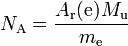
5) The CODATA value for the Avogadro constant is determined from the ratio of the molar mass of the electron Ar(e)Mu to the rest mass of the electron me:

N_{\rm A} = \frac{A_{\rm r}({\rm e})M_{\rm u}}{m_{\rm e}}

m_{\rm e} = \frac{2R_{\infty}h}{c\alpha^2}

The “relative atomic mass” of the electron, Ar(e), is a directly-measured quantity, and the molar mass constant, Mu, is a defined constant in the SI system. The electron rest mass, however, is calculated from other measured constants.

The main limiting factor in the precision to which the value of the Avogadro constant is known is the uncertainty in the value of the Planck constant, as all the other constants which contribute to the calculation are known much more precisely.

http://upload.wikimedia.org/wikipedia/commons/thumb/b/b2/Silicon-unit-cell-labelled-3D-balls.png/200px-Silicon-unit-cell-labelled-3D-balls.png

X Ray Electron mass method (CODATA)


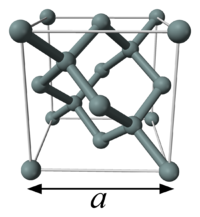
Ball-and-stick model of the unit cell of silicon.

One modern method to calculate the Avogadro constant is to use ratio of the molar volume, Vm, to the unit cell volume, Vcell, for a single crystal of silicon:

6)

N_{\rm A} = \frac{8V_{\rm m}({\rm Si})}{V_{\rm cell}}

The factor of eight arises because there are eight silicon atoms in each unit cell.

The unit cell volume can be obtained by X-ray crystallography; as the unit cell is cubic, the volume is the cube of the length of one side. The isotope proportional composition of the sample used must be measured and taken into account.

Silicon occurs with three stable isotopes – 28Si, 29Si, 30Si – and the natural variation in their proportions is greater than other uncertainties in the measurements.

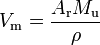
The atomic weight Ar for the sample crystal can be calculated, as the relative atomic masses of the three nuclides are known with great accuracy. This, together with the measured density ρ of the sample, allows the molar volume Vm to be found by:

V_{\rm m} = \frac{A_{\rm r}M_{\rm u}}{\rho}

where Mu is the molar mass constant. The 2006 CODATA value for the molar volume of silicon.

As of the 2006 CODATA recommended values, the relative uncertainty in determinations of the Avogadro constant by the X-ray crystal density method is 1.2 × 10–7, about two and a half times higher than that of the electron mass method.

PROCEDURE

Materials

  • Direct current source (battery or power supply)
  • Insulated wires and possibly alligator clips to connect the cells
  • 2 Electrodes (e.g., strips of copper, nickel, zinc, or iron)
  • 250-ml beaker of 0.5 M H2SO4 (sulphuric acid)
  • Water
  • Alcohol (e.g., methanol or isopropyl alcohol)
  • Small beaker of 6 M HNO3 (nitric acid)
  • Ammeter or multimeter
  • Stopwatch
  • Analytical balance capable of measuring to nearest 0.0001 gram

Obtain two copper electrodes. Clean the electrode to be used as the anode by immersing it in 6 M HNO3 in a fume hood for 2-3 seconds. Remove the electrode promptly or the acid will destroy it. Do not touch the electrode with your fingers. Rinse the electrode with clean tap water. Next, dip the electrode into a beaker of alcohol. Place the electrode onto a paper towel. When the electrode is dry, weigh it on an analytical balance to the nearest 0.0001 gram.

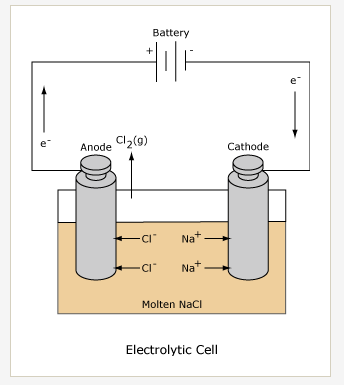
The apparatus looks superficially like this diagram of an electrolytic cell

Notice that we are using two beakers connected by an ammeter rather than

8) having the electrodes together in a solution. Take beaker with 0.5 M H2SO4 and place an electrode in each beaker. Before making any connections be sure the power supply is off and unplugged. The power supply is connected to the ammeter in series with the electrodes. The positive pole of the power supply is connected to the anode. The negative pin of the ammeter is connected to the anode. The cathode is connected to the positive pin of the ammeter. Finally, the cathode of the electrolytic cell is connected to the negative post of the battery or power supply. Remember, the mass of the anode will begin to change as soon as you turn the power on, so have your stopwatch ready!

You need accurate current and time measurements. The amperage should be recorded at one minute (60 sec) intervals. Be aware that the amperage may vary over the course of the experiment due to changes in the electrolyte solution, temperature, and position of the electrodes. The amperage used in the calculation should be an average of all readings. Allow the current to flow for a minimum of 1020 seconds (17.00 minutes). Measure the time to the nearest second or fraction of a second. After 1020 seconds turn off the power supply record the last amperage value and the time.

Now you retrieve the anode from the cell, dry it as before by immersing it in alcohol and allowing it to dry on a paper towel, and weigh it. If you wipe the anode you will remove copper from the surface and invalidate your work!

OBSERVATIONS

The following observations were made:

Anode mass lost: 0.3554 grams (g)
Current(average): 0.601 amperes (amp)
Time of electrolysis: 1802 seconds (s)

Remember:
one ampere = 1 coulomb/second or one amp.s = 1 coul
charge of one electron is 1.602 x 10⁻¹⁹ coulomb

  1. Find the total charge passed through the circuit.
    (0.601 amp)(1 coul/1amp-s)(1802 s) = 1083 coul
  2. Calculate the number of electrons in the electrolysis.
    (1083 coul)(1 electron/1.6022 x 1019coul) = 6.759 x 10²¹ electrons
  3. Determine the number of copper atoms lost from the anode.
    The electrolysis process consumes two electrons per copper ion formed. Thus, the number of copper (II) ions formed is half the number of electrons.
    Number of Cu2+ ions = ½ number of electrons measured
    Number of Cu2+ ions = (6.752 x 10²¹ electrons)(1 Cu2+ / 2 electrons)
    Number of Cu2+ ions = 3.380 x 10²¹ Cu2+ ions
  4. Calculate the number of copper ions per gram of copper from the number of copper ions above and the mass of copper ions produced.
    The mass of the copper ions produced is equal to the mass loss of the anode. (The mass of the electrons is so small as to be negligible, so the mass of the copper (II) ions is the same as the mass of copper atoms.)
    mass loss of electrode = mass of Cu2+ ions = 0.3554 g
    3.380 x 10²¹ Cu2+ ions / 0.3544g = 9.510 x 10²¹ Cu2+ ions/g = 9.510 x 10²¹ Cu atoms/g


  1. Calculate the number of copper atoms in a mole of copper, 63.546 grams.
    Cu atoms/mole of Cu = (9.510 x 10²¹ copper atoms/g copper)(63.546 g/mole copper)
    Cu atoms/mole of Cu = 6.040 x 10²³ copper atoms/mole of copper
    This is  my measured value of Avogadro’s number!
  2. Calculate percent error.
    Absolute error: |6.02 x 10²³ – 6.04 x 10²³ | = 2 x 10²¹
    Percent error: (2 x 10 21 / 6.02 x 10 23)(100) = 0.3 %

Precautions

  • The chemicals should be handled with care to avoid any mishaps.
  • Do not switch on the battery before you have setup the entire circuit.
  • Be accurate while starting and stopping the stopwatch.
  • Do not wipe the anode.

BIBLIOGRAPHY

  1. http://www.iupac.org/goldbook/A00543.pdf
  2. http://gemini.tntech.edu/%7Etfurtsch/scihist/avogadro.htm
  3. http://www.americanscientist.org/issues/pub/2007/2/an-exact-value-for-avogadros-number
  4. http://www.inrim.it/Nah/Web_Nah/home.htm

You can find other Chemistry Projects here.


Antacid for neutralizing stomach acid – Chemistry Project


S.No. Contents II Page No.
I. Objective
II. Introduction
III. Experiment
IV. Material required
V. Procedure
VI. Observation
VII. Result
VIII. Precaution
IX. Bibliography

OBJECTIVE

The purpose of this experiment was to determine which antacid could neutralize the most stomach acid.

I became interested in this idea when I saw some experiments on medicines and wanted to find out some scientific facts about medicines.

The information gained from this experiment will help people know which antacid they should look for in the stores. It will also let them know which antacid will give them the most comfort. This could also save consumers money and provide better health.

INTRODUCTION

Digestion in the stomach results from the action of the gastric fluid, which includes secretions of digestive enzymes, mucus, and hydrochloric acid. The acidic environment of the stomach makes it possible for inactive forms of digestive enzymes to be converted into active forms (i.e. pepsinogen into pepsin), and acid is also needed to dissolve minerals and kill bacteria that may enter the stomach along with food. However, excessive acid production (hyperacidity) results in the unpleasant symptoms of heartburn and may contribute to ulcer formation in the stomach lining. Antacids are weak bases (most commonly bicarbonates, hydroxides, and carbonates) that neutralize excess stomach acid and thus alleviate symptoms of heartburn. The general neutralization reaction is:

Antacid (weak base) + HCl (stomach acid) —> salts + H20 + C02

The hydrochloric acid solution used in this experiment (0.1 M) approximates the acid conditions of the human stomach, which is typically 0.4 to 0.5% HQ by mass (pH ~ 1).Antacids help people who have or get heartburn.

ACIDS

Acids are a group of chemicals, usually in liquid form. They can be recognized by their sour taste and their ability to react with other substances. Acids are confirmed as an acid by their pH. The pH of acids ranges from 0-6.9 (below 7). The two main acids are: mineral acid and organic acid. The three well known acids that are sulphuric acid (H2S04), nitric acid (HN03), and hydrochloric acid (HCl).

STOMACH ACID

Stomach acid is very dangerous. If a person was to have an ulcer and the stomach acid was to escape it would irritate their other organs. Stomach acid is highly acidic and has a pH of 1.6. Stomach acid is hydrochloric acid produced by the stomach. If there is too much stomach acid it can cause heartburn. Heartburn is when stomach acid is produced in abnormal amounts or location. One of the symptoms of heartburn is a burning feeling in the chest or abdomen.

SOME FOODS CONTAINING ACIDS

Almost all foods and drinks and even medicines have ingredients that are different acids. Here are some examples: Aspirin (acetylsalicylic acid), Orange juice (ascorbic acid/Vitamin C), Sour Milk (lactic acid), Soda Water (carbonic acid), Vinegar (acetic acid), Apples (malic acid), and Spinach (oxalic acid).

ANTACID

An antacid is any substance that can neutralize an acid. All antacids are bases. A base is any substance that can neutralize an acid. The pH of a base is 7.1-14(above 7). All antacids have chemical in them called a buffer. When an antacid is mixed with an acid the buffer tries to even out the acidity and that is how stomach acid gets neutralized. In an antacid it is not the name brand that tells how well it works it is something called an active ingredient. Not all antacids have a different active ingredient. Some have one of the same active ingredients and some have all of the same active ingredients. Almost all the antacids that have the same active ingredient work the same amount as the other. The active ingredient of most of the antacids is bases of calcium, magnesium, aluminium.

ACTION MECHANISM

Antacids perform neutralization reaction, i.e. they buffer gastric acid, raising the pH to reduce acidity in the stomach. When gastric hydrochloric acid reaches the nerves in the gastrointestinal mucosa, they signal pain to the central nervous system. This happens when these nerves are exposed, as in peptic ulcers. The gastric acid may also reach ulcers in the oesophagus or the duodenum.

Other mechanisms may contribute, such as the effect of aluminium ions inhibiting smooth muscle cell contraction and delaying gastric emptying.

Antacids are commonly used to help neutralize stomach acid. Antacids are bases with a pH above 7.0 that chemically react with acids to neutralize them. The action of antacids is based on the fact that a base reacts with acid to form salt and water.

INDICATIONS

Antacids are taken by mouth to relieve heartburn, the major symptom of gastro oesophageal reflux disease, or acid indigestion. Treatment with antacids alone is asymptotic and only justified for minor symptoms. Peptic ulcers may require H2– receptor antagonists or proton pump inhibitors.

The usefulness of many combinations of antacids is not clear, although the combination of magnesium and aluminium salts may prevent alteration of bowel habits.

SIDE EFFECTS

  • Aluminium hydroxide: may lead to the formation of insoluble aluminium phosphate complexes, with a risk for hypophosphate and osteomalacia. Although aluminium has a low gastrointestinal absorption, accumulation may occur in the presence of renal insufficiency. Aluminium containing drugs may cause constipation.
  • Magnesium hydroxide: has a laxative property. Magnesium may accumulate in patients with renal failure leading to hypo magnesia, with cardiovascular and neurological complications.
  • Calcium: compounds containing calcium may increase calcium output in the urine, which might be associated to renal stones. Calcium salts may cause constipation.
  • Carbonate: regular high doses may cause alkalosis, which in turn may result in altered excretion of other drugs, and kidney stones.

PROBLEMS WITH REDUCED STOMACH ACIDITY

Reduced stomach acidity may result in an impaired ability to digest and absorb certain nutrients, such as iron and the B vitamins. Since the low pH of the stomach normally kills ingested bacteria, antacids increase the vulnerability to infection. It could also result in the reduced bioavailability of some drugs. For example, the bioavailability of ketocanazole (antifungal), is reduced at high intragastric pH (low acid content).

EXPERIMENT

The constants in this study were:

–   Type of acid

–   Consistency of procedures

The variables in the study were:

-Different types of antacid used

The responding variable was:

–  The amount of stomach acid each antacid could neutralize measured in ml.

MATERIAL REQUIRED

  • Burette
  • Pipette
  • Titration flask
  • Measuring flask
  • Beaker
  • Weighing machine
  • Concentrated Sulphuric acid
  • Methyl Orange
  • Antacid samples

PROCEDURE

  • Prepare half litre of N/10 HCl solution by diluting 10 ml of the concentrated acid to 1 litre.
  • Prepare N/10 sodium carbonate solution by weighing exactly 1.325 g of anhydrous sodium carbonate and then dissolving it in water to prepare exactly 0.25 litre of solution.
  • Standardize the HCl solution by titrating it against the standard sodium carbonate solution using methyl orange as indicator.
  • Take 20 ml of standardized HCl in the conical flask, use methyl orange as indicator and see the amount of base used for neutralization.
  • Powder the various sample of antacids tablets and weigh 10 mg of each.
    • Take 20 ml of standardized HCl solution in the conical flask; add the weighed samples to it.
    • Add two drops of methyl orange and warm the flask till most of the powder dissolves. Filter off the insoluble material.
    • Titrate the solution against the standardized Na2C03 solution till a permanent red tinge appears.
    • Note the amount of base used for titration and note the reduction in the amount of base used.
    • Repeat the experiment with different antacids.

OBSERVATIONS

Volume of N/10 sodium carbonate solution taken—20.0 ml

S. No. Initial burette Final burette Volume of acid
readings readings used (in ml)
1 0.0 ml 15 ml 15.0
2 0.0 ml 14 ml 14.0
3 0.0 ml 15 ml 15.0

Concordant reading—15.0 ml Applying normality equation

N1V1(acid) N2V2(base)

N (15) — (1/10) 20

Normality of HCl solution, N1 — 0.133 N

2. Neutralization of standardized HCl solution used

3. Analysis of antacid tablets

Weight of the antacid tablet powder— 10 mg Volume of HCl solution added— 20.0 ml

S. No. Antacid Initial reading of burette Final reading of burette Volume of Na2C03
1 Gelusil 0.0 ml 15.0 ml 15 ml
2 Aciloc 150 0.0 ml 22.0 ml 22 ml
3 Fantac 20 0.0 ml 25.0 ml 25 ml
4 Pantop 20 0.0 ml 20.0 ml 20 ml
5 Ocid 10 0.0 ml 7.0 ml 7 ml

RESULT

The most effective antacid out of the taken samples is acid 10.

PRECAUTIONS

  • All apparatus should be clean and washed properly.
  • Burette and pipette must be rinsed with the respective solution to be put in them.
  • Air bubbles must be removed from the burette and jet.
  • Last drop from the pipette should not be removed by blowing.
  • The flask should not be rinsed with any of the solution, which are being titrated.

Bibliography

  • Website : http:/ /www.encarta.com
  • NCERT Chemistry-12
  • Comprehensive Practical Chemistry -12

You can find other Chemistry Projects here.