
College\University
Law School
Floral Dissection
Aim: Study and discuss the given flowering plants and give its floral formula
Requirement: Flower, Forceps, Blade, Slides, Cover Slip, Microscope, Tape
LILIUM CANDIDUM
Kingdom: Plantae
Division: Anglospervae
Class: Monocot
Family: Liliaceae
Genus: lilium
Species: Candidum
Overay: Trilocular
Root: Advertitious Root
Stem: Herbaceous, erect
Tepals: 6 in number
Infloresnce: Racenose or umbel
Flower: Bracteate, bisoual, actionopic
Floral Formula
Br ⊕♀P3+3 A3 G(3)

This website also contains other Class XI Practicals on Biology, Physics, and Chemistry.
Study the pH and water holding capacity of different soil samples.
AIM: To study the pH and water holding capacity of different soil samples.
REQUIREMENTS: Soil samples, measuring cylinders, funnel, filter papers and pH indicator.
PROCEDURE:
Take 2 funnels and line them with filter paper
Put these funnels in a measuring cylinder
Put the 2 soil samples in separate funnels
The weight of soil sample should be same in both (25g)
Pour equal amount of water in both funnels (25 ml)
Let the water drip in the cylinder
Not the volume of water collected
OBSERVATIONS:
The volume of water collected in cylinder of sample A was more than sample B
Also, the pH of sample A was higher
Calculations:
Volume of water retained by soil = Vol. of H2O poured-Vol. of H2O collected in cylinder
Water holding capacity = (Vol of H2O retained/Vol of H2O required) x 100
CONCLUSION:
Soil sample A is roadside soil and sample B is garden soil as sample B has more water holding capacity.
PRECAUTIONS:
The water should be poured slowly
The measuring cylinders should be properly calibrated.
Study and identify the transverse section of testes and ovary through permanent slides.
Aim: To study and identify the transverse section of testes and ovary through permanent slides.
Requirements: Permanent slides of transverse section of Testes and ovary, microscope
Observation:
T.S of Mammalian Testes
The mammalian testes are covered with a thick fibrous tissue called tunica albuginea
The testes consist of a many seminiferous tubules embedded in the interstitial tissues.
Various types of cells are present from outside towards the lunar in the following order:-
Spermatogonia(2n)———>Spermatocytes ( ) ———>Sepermatids———>Spermatozoa(n) i.e. sperms
Between the germinal cells, pyramidal shaped cells called Sertoli cells are present
A large number of sperms have their head embedded in the Sertoli cells.
The interstitial tissue has Leydig cells which produce testosterone.
T.S. of Mammalian Ovary
A mammalian ovary is a solid structure bounded germinal epithelium followed by a thick layer of fibrous tissue called tunica albuginea.
The ovary consists of the outer cortex and inner medulla.
The medulla consists many rounded or oval bodies called ovarian follicles at various stages of development.
The development of follicle is as follows:-
10 follicle——>20 follicle—–>30 follicle—->Graffian follicle—–>corpus luteum
The cortex contains round and mature follicles along with corpus luteum.
Precaution:
Handle the microscope with care
Use find adjustment for better focus
You can also get Class XII Practicals on Biology, Physics, and Physical Education.
Study Pollen Germination on a Slide
Aim: To study pollen germination on a slide.
Apparatus and materials required: Fresh seasonal flower slides, microscope, beaker, cavity slide, boric acid, sucrose.
Procedure:
Prepare a nutrient solution by dissolving 10g sucrose and 10 mg boric acid in 100 ml water.
Take a few drops of this solution on a clear slide, dust a few pollen grains from the stamen of a mature flower in it.
Obverse the slide under the microscope after 5 minutes. Keep observing the slide regularly after intervals of half an hour.
Observations:
In a nutrient solution or nutrient-rich medium, the pollen grains germinate. The tube/vegetative cell enlarges and comes out the pollen grains through one of the germ pores to form a pollen tube. The generative cell nucleus soon passes into it and dives to make 2 sperm nuclei (male gametes). Each male gamete is lenticular to spherical in outline.
Precautions:
Flowers should be freshly picked
Use a clear cavity slide to observe pollen grain


You can also get Class XII Practicals on Biology, Physics, and Physical Education.
Internal Resistance Of a Given Primary Cell Using a Potentiometer
OBJECTIVE
To determine the internal resistance of a given primary cell using a potentiometer.
APPARATUS
A potentiometer, a battery (or battery eliminator), two one-way keys, an id resistance, a galvanometer, a high resistance box, a fractional resistance box, an ammeter, voltmeter, a cell (say Leclanche cell), a jockey, a set square, connecting wires and sandpaper.
CIRCUIT DIAGRAM
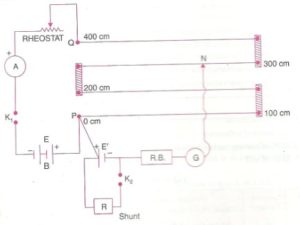
THEORY
When Key K2 is open and K1 is closed,
Let null point be obtained at a distance l1 from A
Therefore E = Kl1 –> (1)
When Key K2 is closed and K1 is open,
Let null point be obtained at a distance l2 from A
Therefore V = Kl2 –> (2)
(1) divided by (2)
E/V = l1/l2
(S+r)/S = l1/l2
r = S*(l1-l2)/l2
Where S : the shunt resistance in parallel with given cell.
l1 and l2 : Balancing lengths without and with shunt respectively.
r : internal resistance of the cell.
PROCEDURE
- Make the connections as shown in circuit diagram.
- Clean the ends of the connecting wires with sandpaper and make tight connections. Tighten the plugs of the resistance box.
- Check the E.M.F. of the battery and cell and see that E.M.F. of the battery is more than that of the given cell otherwise null or balance point won’t be obtained. (E’ > E)
- Take maximum current from the battery, making rheostat resistance small.
- Insert the plug in Key K1 and adjust the rheostat so that a null point is obtained or the fourth wire of potentiometer.
- Insert the 2000 Ohm plug in its position in resistance box and obtain a null point by slightly adjusting the jockey.
- Measure the balancing length L1.
- Take out the 2000 Ohm plug from the resistance box. Introduce the plugs in Key K1, as well as in Key K2. Take act a small resistance from the resistance box R connected in parallel with the cell. Slide the jockey along the potentiometer wire and obtain a null point. Insert the 2000 Ohm plug back in its position in R.B. and make a further adjustment for a sharp null point.
- Insert the 2000 Ohm plug back in its position in R.B. and make a further adjustment for a sharp null point.
- Measure the balancing length l2 from end P.
- Remove the plugs keys K1 and K2. Wait for some time and respect the activity for the same current.
- Record your observations.
OBSERVATIONS
- Range of voltmeter
- Least count of voltmeter
- E.M.F. of battery (or battery eliminator)
- E.M.F. of cell
CALCULATIONS
RESULT
The internal resistance of the given cell is…………… ohm.
PRECAUTIONS
- The e.m.f. of the battery should be greater than that of the cell.
- For one set of observation, the ammeter reading should remain constant.
- Current should be passed for a short time only while finding the null point.
You can also get Class XII Practicals on Biology, Physics, and Physical Education.
Viva Voce – Questions on Protein, Fat, Carbohydrate Test
- What are proteins? Name their basic unit.
Proteins are complex nitrogenous organic compounds of high molecular masses. Amino acids are the basic unit of proteins.
- What is the ring due to in Molisch’s test?
Concentrated sulphuric acid (H2SO4) produces furfural or its derivative on reacting with carbohydrates. This furfural forms a violet coloured compound on coupling with naphthol.
- What is the chemistry of Acrolein Test?
Oil or fat gets hydrolyzed to free glycol which forms pungent smelling acrolein on further reaction.

You can also get Class XII Practicals on Biology, Physics, and Physical Education.
Viva Voce – Questions on Preparation of Sols
- What is a sol?
Sol is a colloidal suspension of a solid in a liquid.
- What is the criteria for classifying sols? What type of sols are known?
Sols are classified based on their affinity for the dispersed phase for the dispersion medium. There are types of sols – lyophobic and lyophilic.
- What is the difference between lyophilic and lyophobic sol?
A sol in which colloidal particles have an affinity for the dispersion medium is called lyophilic sol whereas, in a lyophobic sol, colloidal particles have no or very little affinity for the dispersion medium.
- What is meant by ‘dialysis’?
The phenomena of purification of sols by passing through a semipermeable membrane is known as dialysis.
- What is the special characteristic of the paper used in dialysis?
It only permits the electrolyte to pass through it and doesn’t allow the passage of colloidal particles.
- What is the nature of charge on (i) ferric hydroxide and (ii) arsenious sulphide sols?
Ferric hydroxide sol is positively charged whereas arsenious sulphide is negatively charged.
You can also get Class XII Practicals on Biology, Physics, Chemistry, and Physical Education.
