
Aim : To determine resistance of a galvanometer by half deflection method and to find its figure of merit .
Apparatus : A Weston type of galvanometer , a voltmeter , a battery /battery eliminator , two 10,000 ohm and 200 ohm ) resistance boxes , two one way key , a rheostat , a screw gauge , a meter scale , an ammeter of given range , connecting wires and a piece of sand paper .
Theory
The resistance of the given galvanometer as found by half deflection method .
G= (RxS)/(R-S) (1)
Where R is the resistance connected in series with the galvanometer and S is the shunt resistance .
The figure of merit , K =E /[(R+G)Q] (2)
Where E is the end of the cell and Q is the deflection produced with resistance R.
The maximum current that can pass through the galvanometer , Ig=nk
Where n is the total number of dimension on the galvanometer scale on either side of zero .
Procedure
1. Resistance of galvanometer by half deflection method
- Make the connections accordingly as shown in circuit diagram .
- See that all plugs of the resistance boxes are tight
- Take out the high resistance (200 Ohm ) from the resistance box R and insert key K1 only .
- Adjust the value of R1 so that deflection is maximum , even in number and within the scale .
- Note the deflection . Let it be Q.
- Insert the key k2 also and without changing the value of R2 ,adjust the value of S , such that deflection in the galvanometer reduces to exactly half the value of resistance S.
- Note the value of resistance S .
- Repeat step 4 & 7 three times taking different R and adjusting .
2. Figure of merit
- Take one cell of the battery and find its emf by a voltmeter by connecting +ve of the voltmeter with +ve of cell and – ve of the voltmeter with -ve of cell . Let it be E.
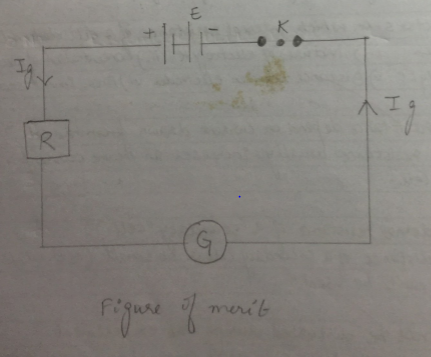
- Take connection as in circuit diagram .
- Adjust the value of R to obtain a certain deflection Q when circuit is closed .
- Note the value of resistance R and deflection Q.
- Now change the value of R and note the galvanometer deflection again .
- Repeat the step with both cells of the battery with different voltages like 2,4,6 ,8 volts from battery eliminator.
- Find the figure of merit K using the formula
Observation table
| Resistance (R) | Deflection (Q) | Shunt (S) | G =(RxS)/(R-S) |
| 5000 | 10 | 5 | 5.005 |
| 10000 | 6 | 3 | 3 |
| 2000 | 20 | 10 | 10.05 |
| 1500 | 26 | 3 | 13.11 |
| Average | G = 7.79 ohms | ||
| Resistance (R) | Deflection (Q) | K |
| 5000 | 9 | 0.556 |
| 10000 | 5 | 0.60 |
| 2000 | 20 | 0.502 |
| 1500 | 25 | 0.524 |
| Average | K = 0.5455 A/dn | |
Calculations
- G = (5.005+3+10.05+13.11)/4 [E = 1.45V]
- Figure of Merit : Current in the galvanometer per unit time
- K = IQ = [(E)/(R+G)]x[1/Q] – SI unit = AD division = 10-5 Al div
Result
Resistance of given galvanometer is 7.79 ohm .
Figure of merit of given galvanometer is 0.545 A/dn .
Precautions
All connections should be neat and tight .
The emf of cell / battery should be constant .
Source of error
The scene of the instrument may be loose .
The galvanometer division may not be of equal size.
Diagram
Resistance of Galvanometer
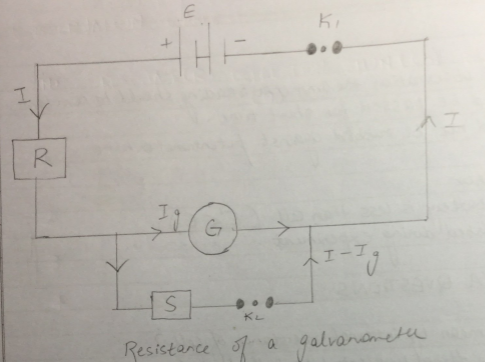
Figure of Merit
Viva question
What is the galvanometer ?
It is a device used for detecting feeble electric currents in circuit .
Define the figure of merit of a galvanometer ?
The quantity of current required to produce a deflection of one division in the galvanometer is called figure of merit of a galvanometer . It is represented by K . Its unit is ampere per division .
Why is this method called half deflection method ?
It is so because the deflection is made half by using a shunt resistance S.
Under what condition id the resistance of a galvanometer (E1) equal to shunt resistance (S)?
E1=S , only when series resistance R is very high .
You can also get Class XII Practicals on Biology, Physics, and Physical Education.

Need to see graph
Thank you
Soapstone first-aid
Need to update I think it’s older version some coloum are missing in observations table
Thnku so much..ur an angel..really love u
hahahahaha
ya same
thank you soooo much ,
Thsnks for suggestion
You have not told emf of the cell
yess EXACTLY
Thank you… It is quite helpful.
Wo
Awesome work
Not a single add
Experiment=5
Thanks
Thanks
I need a discussions …please give me a discussions for this Experiment
I need a discussions …please give me a discussions for this Experiment
Plz check the observation table and update because some column are missing 🙁
Very much thankful to have this…
Nice works
Nice works
Awesome work
Really thankful to have it
Fantastic work
Nice to have it
are these much viva questions enough
Plz draw graph of this experiment
Plz draw graph of this experiment
Thanks
Their is mistake in 1 table 4 no G=13.11 this value is wrong check it.
S it should be 3.11 i guess
You have not told the emf of the cell and even some columns are missing in the table
thanks
Thankyou so much dear really helpful.
Where is graph I want to see now