Constitution – II (Federalism and Government)

You can grab notes for other law subjects from here.

Test for glucose, sucrose, proteins, fats & shows their presence in suitable plant & animal materials

AIM: To test for glucose, sucrose, proteins, fats & shows their presence in suitable plant & animal materials (e.g. – wheat, potato, groundnut, milk or other materials)

REQUIREMENTS: Wheat grain, potato, groundnut, milk, egg, grapes/apple/banana, filter paper, test tubes, funnel, beaker, burner, Benedict’s solution, Fehling’s solutions, Biuret reagent, Million’s, Sudan III, NaOH, HCl, HNO3 etc.

PROCEDURE: Soak the suitable material (wheat, groundnut or rice). Grind them separately & make their paste. Similarly make a paste of potato, fruits & egg album in separately. Filter the content of all these in separate test tubes & label them. Use these filtrates for testing.

TEST OBSERVATION INFERENCE
1.TEST FOR GLUCOSE

(i) BENEDICT’S TEST

Take 2ml of fruit juice in a test tube. Add 2ml of Benedict’s solution to it. Boil test tube for 2 minutes & cool.

(ii) FEHLING’S TEST

Take 2ml of fruit juice in a test tube & add 2ml of each of Fehling’s solution A & Fehling’s solution B in it & boil.

A green ppt appears in the solution, which may later turn orange or brick red in colour

Orange or brick red ppt. appears in the test tube.

Shows the presence of glucose. Green ppt shows presence of glucose in lesser concentration, orange or red ppt indicate the presence in higher concentration.

Shows presence of glucose (Monosaccharide)

2. TEST FOR SUCROSE

Take 2ml of sugar cane juice. Add a few drops of HCl & boil the test tube gently for one or two minutes. This hydrolyses sucrose into glucose & fructose. Make the solution alkaline with NaOH. Now perform Benedict’s or Felling’s test with this solution for presence of glucose

Orange or brick red ppt is observed in the test tube. Positive test with Benedict’s/ Ferling’s solution shows the presence of sucrose in juice tested.
3. TEST FOR STARCH

(i) IODINE TEST

Take 2ml extract (potato/gram/rice) in a test tube & add a few drops of iodine solution to it.

(ii)BENEDICT’S/FEHLING’S

Test after hydrolysis. Take 2ml of starchy solution. Hydrolyse it by boiling with a few drops of HCl. Make the solution alkaline by adding NaOH & perform Benedict’s/Fehling’s test.

Blue-black colour is observed.

Brick red or orange ppt is observed.

Shows the presence of starch.

Positive test with Benedict’s solution shows the presence of starch.

4. TEST FOR PROTEINS

(i) BIURET TEST

Take 3ml of 5% NaOH in a test add 2 drops of 1% CuSO4. Shake it thoroughly now in a 2nd test tube take 2ml of the extract (grapeseed)

(ii) XANTHOPROTEIC TEST

  1. Take 2ml of the extract in a test tube & add 2-3 drops of concentrated HNO3 to it
  2. Cool the solution, dilute it with H2O & add few drops of ammonia

MILLON’S TEST


Take 2 ml of the extract in attest tube & add 2ml of Millon’s reagent to it.

Pink, red or violet colour is observed.

Yellow ppt observed.

Yellow ppt changes to orange.

Rink or red colour is seen.

Show presence of proteins.

Indicates the presence of protein


Protein indicated

5. TEST FOR FATS

(i) Take a 1 ml of extract (peanuts/castor seeds) in a test tube & shake the solution vigorously. Dip a glass red in the solution & put its spot on the white paper.

(ii) Crush peanut/ castor seed & rub it on a piece of white paper.

(iii) Take 2ml of the extract in a test tube & add 1ml of Sudan III to it.

Paper becomes translucent at the spot.

A translucent spot appears the paper.

Pink droplets appear in the solution.

Indicates presence of fat

Indicate presence of fat.

Shows presence of fat.

This website also contains other Class XI Practicals on BiologyPhysics, and Chemistry.

Study Of Character Of Plant Specimens And Identification With Reasons

Study Of Character Of Plant Specimens And Identification With Reasons

AIM: Study of character of : Spirogyra, Rhizopus, Mushroom/Bracket fungi, Liver wort, Moss, Fern, Pinus, One Monocotyledon, One Dicotyledon, Yeast & lichens.

REQUIREMENTS: Prepared slides or preserved specimens, record file, pencil, a laboratory guide etc

AGARICUS (MUSHROOM)

Classification:-

  • Kingdom – Fungi
  • Division – Eumycophyta
  • Class – Basidiomycetes
  • Genus – Agaricus
  • Species – Compestris

Agaricus

COMMENTS: It is a saprophytic fungus that grows in hum & rich soils piles of straw & rotting wooden logs

It has septate mycelium under the substratum. The mycelium produces white & creamy coloured umbrella shaped ‘ fruit bodies’ or ‘basidiocarp’ above the substratum.

Pileus is circular, umbrella like & bear a number of vertical plate like structure called gills.

DIAGNOSTIC FEATURES: The fruiting body is umbrella shaped

Gills are present on the lower side of the pileus

SACCHAROMYCES (YEAST)

Classification:-

  • Kingdom – Fungi
  • Division – Eumycophyta
  • Class – Ascomycetes
  • Genus – Saccharomyces sp.

Saccharomyces

COMMENTS: It is commonly found growing in sugary medium such as fruit surface, nectar, cane juice etc

It is unicellular but may form a ‘pseudomycelium’ by repeated budding

Yeast cell is oval or elliptical in shape with a distinct cell wall made up of chitinous material

Volutin granules & glycogen droplets are present as reserve food in cytoplasm

DIAGNOSTIC FEATURES : Unicellular

Presence of nuclear vacuole

Reproduction by budding

RICCIA (LIVERWORT)

Classification :-

  • Kingdom – Plantae
  • Division – Bryophyta
  • Class – Hepaticeae
  • Genus – Riccia

Riccia

COMMENTS: The plant body is a dorsoventrally flattered & dichotomously branched thallus. It may form a rosette due to repeated dichotomous branching of thallus

Scales and rhizoids are present on the ventral surface. Scales protect the growing apex and retain moisture

Rhizoids are unicelluclar, colourless and tabular. They help in anchorage & absorption

The thallus represents haploid gametophytic stage

DIAGNOSTIC FEATURES: Plant body is a thallus with repeated dichotomous branching

Sex organs & sporophyte embedded in the thallus

FUNARIA HYGROMETRICA (MOSS)

Classification:-

  • Kingdom – Plantae
  • Division – Bryophyta
  • Class – Musci
  • Genus – Funaria
  • Species – Hygrometrica

Funaria Hygrometrica

COMMENTS: The plant body is gametophyte. It is green, erect & is differentiated into rhizoids, axis (stem) & leaves

Rhizoids are multicellular and branched with oblique septa

The main axis is erect and bears spirally arranged lenses

Sporophyte is differentiated into foot, seta & capsule

DIAGNOSTIC FEATURES: Gametophyte is represented by a filamentous protonema & adult leafy gametophyte

Rhizoid branched and obliquely separate

Sporophyte is a partial parasite upon the gametophyte

DRYOPTERIS (MALE FERN)

Classification:-

  • Kingdom – Plantae
  • Division – Pteridophyta
  • Class – Filicinae
  • Genus – Dryopteris

Dryopteris

COMMENTS: The plant body is sporophyte & is differentiated into root, stem (underground rhizome) & pinnately compound leaves

The young leaves have circinate ptyxis & are covered with hair called ramenta

The spores are haploid which give rise to heart shaped membranous gametophyte called prothallus

DIAGNOSTIC FEATURES: Stem is rhizome

Young leaves have circinate ptyxis & bear rementa

Leaves pinnate with furcate venation

PINUS ROXIBURGHI (CHIR)

Classification:-

  • Kingdom – Plantae
  • Division – Spermatophyte
  • Class – Gymnospermae
  • Genus – Pinus
  • Species – Roxburghii

Pinus Roxburghii

COMMENTS: Stem is covered with bark & bears types of branches long shoots and dwarf shoots. The long shoots bear scale leaves & grow indefinitely by apical bud, whereas dwarf branches bear scale leaves & foliage leaves are of limited growth.

Pinus tree is monoecious & bears both male & female cones

The plant body is sporophyte. Differentiated into root, stem & leaves.

DIAGNOSTIC FEATURES: Evergreen, woody, perennial tree

Seeds are naked

Presence of long shoots & dwarf shoots

Reproductive organs are cones

DICOTYLEDONOUS PLANT

  • BRASSICA CAMPESTRIS

Classification:-

  • Kingdom – Plantae
  • Division – Spermatophyta
  • Class – Angiospermae
  • Sub class – Dicotyledonous
  • Species – Campestris

Brassica Campestris

COMMENTS: Stem is soft green with distinct nodes & internodes

The leaves are alternate sessile, simple with lobed margin & reticulate venation

It bears colour yellow flower for reproduction. Each flower is bisexual & bimerous with cruciform corolla

DIAGNOSTIC FEATURES: Tap root system

Leaves with reticulate venation

Binerous flowers

Seeds are enclosed in fruits

Embryo with two cotyledons

MONOCOTYLEDONOUS PLANT

  • SPHODELOUS TENEUFOLIUS (PIAZI)

Classification:-

  • Kingdom – Plantae
  • Division – Spermataophyta
  • Class – Angiospermae
  • Sub class – Dicotyledonae
  • Genus – Sphodelous
  • Species – Teneufolius

Piazi

COMMENTS: It bears adventitious root system

Leaves are bone in cluster. Each leaf is cylindrical, hollow &has parallel variation

The seed enclosed an embryo with only one cotyledon

DIAGNOSTIC FEATURES: Adventitious root system

Leave with parallel venation

Flowers trimerous

Seeds enclosed in fruits

Embryo with one cotyledon

LICHENS A SYMBIOTIC ASSOCIATION)

Lichens are composite organisms representing a symbolic association between a fungus & an alga

Lichens grow on lands, rocks, tree trunks & walls of houses, like dry vegetation

The thallus of lichen resembles neither alga nor fungus

In a lichen thallus the algae individual called mycobiant belongs to ascomycetes or basidiomycetes

Phycobient belongs to chlorophyceae or mynophycaea

Lichen reproduces vegetatively by fragmentation, asexually by soredia & isidia

Sexual organs like those in Ascomycates are formed

This website also contains other Class XI Practicals on BiologyPhysics, and Chemistry.

Study Of Characters Of Animal Specimens And Identification With Reasons

Study Of Characters Of Animal Specimens And Identification With Reasons

AIM: Study of characters of specimen and identification :-
Amoeba, Fasciola Hepatica (Liver Fluke), Round worm (Ascaris Lumbricoides), Hirudinaria (Leech), Pheretima Posthuma (Earthworm), Palaemon (Prawn), Bombyx Mori (Silk worm), Pila Globosa (Apple Snail), Asteria (Star Fish), Scoliodon (Dog fish/ Shark ), Hydra, Starfish, Frog, Labeo Rohita (Rohu), Pigeon, Rabbit.

REQUIRED: Fresh or preserved animal specimens, record file, pencil, eraser, sharper, rules, a laboratory guide or practical file.

AMOEBA PROTEUS

Classification:-

  • Kingdom – Protista
  • Phylum – Protozoa
  • Class – Sarcodine
  • Order – Amoebida
  • Genus – Amoeba
  • Species – ProteusAmoeba Proteus

COMMENTS: Amoeba occurs in ponds, ditches lakes, streams etc, having plenty of decaying organic matter.

It is unicellular, microscope, grayish in colour and is about 0.2 to 0.5 mm in diameter.

Under the microscope, a living Amoeba appears like an irregular jelly like, tiny mass of hyaline protoplasm. The protoplasm can be distinguished into an outer octoplasm & inner endoplasm.

Diagnostic Features: Unicellular & irregular shape of the shape.

Presence of finger like & blunt pseudopodia.

Presence of contractive vacuole

FASCIOLA HERPATICA (LIVER FLUKE)

Classification:-

  • Kingdom – Animalia
  • Phylum – Platyhelminthes
  • Class – Trematoda
  • Order – Echinostoma
  • Genus – Fasciola
  • Species – Hepatica

Liver Fluke

COMMENTS: It is an endoparasite found in the bile ducts of sheeps, goats, cattles, sometimes other vertebrates excluding man.

It causes serious liver diseases called liver rot.

It is somewhat triangular, flat, leaf like parasite about 25mm in length. It has an oval and ventral sucker (acetabullum) used to adhere to the bile duct.

The body is covered by cuticle with spinules.

DIAGNOSTIC FEATURES: The body is triangular & leaf like

Body is covered with cuticle

Presence of two suckers

ASCARIS LUMBRICOIDES (ROUND WORMS)

CLASSIFICATION:-

  • Kingdom – Animalia
  • Phylum – Nemathelminthes
  • Order – Ascaroidea
  • Genus – Ascaris
  • Species – Lumbrecoides

Ascaris Lumbrecoides


COMMENTS: It’s a common intestinal parasite of a man especially children. Occasionally it may occur in the intestine of pig, sheep, cattle etc.

It has a cylindrical body with tapering ends. The front ends of the body have a terminal triradiate mouth surrounded by three lips.

A little behind anterior end, there is a small excretory pore.

DIAGNOSTIC FEATURES:

Endoparasite

Body covered with cuticle

Mouth guarded by three lips

Elongated body with tapering ends

HIRUDINARIA GRANULOSA (LEECH)

Classification :-

Kingdom – Animalia
Phyllum – Amelida
Class – Hirudiniaria
Order – Grathobdellida
Genus – Hirudinaria
Species – Granulosa

Hirudinaria
COMMENTS: It’s found in ponds, lakes, rivers, swamps and in moist soil near them

It’s a facuttative ectoparsite of cattle and other mammals. It sucks blood (saguinious) by periodically coming in contact with the host body.

Its body is somewhat dorso- vertically flattered and measures about 15 cm in length but it can stretch its length upto 30 cm when required. It is olive green in colour.

DIAGNOSTIC FEATURES: Slimy, elongated & segmented body

Presence of anterior & posterior suckers

PHERETIMA POSTHUMA (EARTHWORM)

Classification :-

  • Kingdom – Animalia
  • Phylum – Amelida
  • Class – Oligochaetra
  • Order – Terricelae
  • Genus – Pheretima
  • Species – Posthuma


Pheretima

COMMENTS: The segments 14th, 15th & 16th form a band called clitellum. It focuses one or more egg cases or cocoons in which ova are laid & fertilized.

Mouth is present at the anterior end. A fleshy lobe called prostomium dorsally over hangs upon the mouth like a hood. Anus is preset in the last segment.

Each segment except the first & the last bears row of minute yellowish setae for locomotion.

DIAGNOSTIC FEATURES: Elongated cylindrical & segmented body

Presence of prostomium & clitellum

Earthworm has setal for locomotion,

PALAEMON (PRAWN)

Classification :-

  • Kingdom – Animalia
  • Phylum – Arthropoda
  • Class – Crustaceae
  • Order – Decapoda
  • Genus – Palaemon
  • Species – Malcolmsonii

COMMENTS : The body is curved & is almost 5 to 18 cm long. It is distinguished into cephalothorax & a long abtomer. The cephalothorox is dorsally covered by a hard carapa which extends as a serrated process called rostrum. Cephalothorax bears eight pairs of segmented legs & on a pair each anterrae, anterrrules & stalked compound eyes.

DIAGNOSTIC FEATURES: Brown coloured spindle shaped & curved body

Abdomen six segmented

Cephalothorax is covered by a carapace with serrated rostrum.

BOMBYX MORI (SILKWORM)

Classification :-

Kingdom – Animalia
Phylum – Arthropoda
Class – Insecta
Order – Lepidoptera
Genus – Bombyx
Species – Mori
Life Cycle of Mammoth


COMMENTS:Adult silk moth is about 25cm long with two pair of wings. It is creamy white in colour

The body is divisible into head, thorax & abdomen & is covered by minute scales.

The larva undergoes four months & then stop feeding. It secretes a sticky fluid through its spinnerets, which on coming in contact with air becomes silk thread & remains wrapped around its body to form pupa

DIAGNOSTIC FEATURES:

Body is divisible into head, thorax & abdomen

Larva form cocoon

Presence of two pairs of wings & three pairs of legs

BOMBYX MORI (SILK WORM):

Classification:-

  • Kingdom – Animalia
  • Phylum – Arthropoda
  • Class – Insecta
  • Order – Lepidoptera
  • Genus – Bombyx
  • Species – Mori

COMMENTS:

Adult silk moth is about 2.5 cm long with two pairs of wings. It is creamy white in colour.

The body is divisible into head, thorax & abdomen & is covered by minute scales

The larva undergoes four months & then stop feeding. It secretes a sticky fluid through its spinnerets, which on coming in contact with air becomes silk thread & remains wrapped around its body to form pupa

DIAGNOSTIC FEATURES

Body is divisible into head, thorax & abdomen

Larva form cocoon

Presence of two pairs of wings & three pairs of legs

PILA GLOBOSA (APPLE SNAIL)

Classification :-

  • Kingdom – Animalia
  • Phylum – Mollusca
  • Class – Gastropoda
  • Order – Prosobranchiata
  • Genus – Pila
  • Species – Globosa

Pila Globosa

COMMENTS: It has a soft & slimy body enclosed in a coiled calcareous shell. The opening of the shell is closed by a thick plate like operculum.

The body is differentiated into head, foot, visceral mass & mantle

Sexes are separate with slight sexual dimorphism

DIAGNOSTIC FEATURES: Skell is univalved & coiled

Foot is muscular & board

Head distinct with eyes & tentacles

ASTERIAS (STAR FISH)

Classification:-

  • Kingdom – Animalia
  • Phylum – Echinodermata
  • Class – Asterioda
  • Order – Forcipulata
  • Genus – Asterias
  • Species – Rubers

Asterias

COMMENTS: The oral surface directed downwards & bears pentagonal mouth in the central disc

Sexes are separate without sexual dimorphism

Aboral surface bears large number of short & movable spines. Anus is present in the centre of the disc.

DIAGNOSTIC FEATURES: Body pentagonal & star shaped

Each arm with four rows of tube feet

Oral & aboral surfaces are quite distinct

SCOLIDON (SHARK/DOG FISH)

Classification:-

  • Kingdom – Animalia
  • Phylum – Chordata
  • Subphylum – Vertebrata
  • Class – Chondrichthyes
  • Genus – Scoliodon sp.

Scoliodon

COMMENTS: It has somewhat laterally compressed & spindle shaped or streamlined body with painted snout

The body is differentiated head, Trunk & tail.

Sexes are separate. Sharks are viviparous

Two mid dorsal, one mid ventral, one caudal & two pairs of lateral fins are present.

LABEO ROHITA (ROHU)

Classification :-

  • Kingdom – Animalia
  • Phylum – Chordata
  • Sub-phylum – Vertebrata
  • Class – Osteichthyes
  • Genus – Labeo
  • Species – RohitaLabeo Rohita

COMMENTS: It is a fresh water dweller commonly called rohu fish, widely used as food.

Mouth is sub- terminal & ventral. A pair each of nostrils & large lateral eyes without eyelids

There are five gills slits covered by operculars

It measures 80-90cm in length. It is covered with overlapping cycloid scales.

RANA YIGRINA (FROG)

Classification:-

  • Kingdom – Animalia
  • Phylum – Chordata
  • Sub-Phyllum – Vertbrata
  • Class – Amphibia
  • Order – Anura
  • Genus – Rana
  • Species – Tigrina

Rana Tigrina

COMMENTS: It has somewhat triangular, bilaterally symmetrical, body with head & trunks.

The skin is dark green with black patches, moist & is covered by mucus.

Eyes bulging out without eyelid. Underwater, eyes are protected by their membrane called nictitating membrane.

Sexes are separate. Development is indirect

ORYTOLAGUS CUNICULUS (RABBIT)

Classification:-

  • Kingdom – Animalia
  • Phylum – Chordata
  • Sub phylum – Vertebrata
  • Class – Mammalia
  • Order – Lagomorpha
  • Genus – Oryctolagus
  • Species – Cuniculus

Oryctolagus Cuniculus

COMMENTS: It’s a body is divided into head, neck & trunk & small bushy tail. The body is covered with hair of white brown or black colour

Two largely movable pinnae present behind eyes. The eyes are pink in colour

The mouth is bounded by soft & fleshy upper & lower lips

Sexes are separate with sexual dimorphism

Females have mammary glands with nipples in the abdomen

HEMIDACTYLUS (WALL LIZARD)

Classification:-

  • Kingdom – Animalia
  • Phylum – Chordata
  • Sub – Phylum – Reptilia
  • Order – Lacertilia
  • Genus – Hemidactylus sp.

Hemidactylus

COMMENTS: Its body is 8-14 cm long, brown in colour & is distinguished into thick & flattered head, short, neck, large trunk & a tapering tail.

The head has pairs of eyes with movable eyelids, nostrils, & ear opening.

The skin is dry, covered with minute scales. The tail with annular pores of scales, which can be scales that can be broken off.

Limbs four in number, each with five clawed digits

COLUMBA LIVIA (PIGEON)

Classification :-

  • Kingdom – Animalia
  • Phylum – Chordata
  • Sub phylum – Vertebrata
  • Class – Aves
  • Genus – Columba
  • Species – Livia

Columba Livia

COMMENTS: Its body is 20 to 25 cm long & covered with slate blue feathers

It has a subspherical head, mobile neck, thick trunk & short tail.

The eyes are red in colour.

The beak is small & slightly curved in front


HYDRA

Classification :-

  • Kingdom – Animalia
  • Phylum – Crideria
  • Class – Hydrozoa
  • Order – Hydrozoida
  • Genus – Hydra
  • Species – Vulgaris

Hydra

COMMENTS: The body consists of an elongated tube with closed base & single opening at oral end.

Body wall consists of two layers of cells (Diploblastic)

Epidermis consists of stinging cells or cnidocytes to act as organ of defence & offence

DIAGNOSTIC FEATURES: Soft bodies & diploblastic

Body is elongated & saclike

Presence of tentacles & stinging cells

This website also contains other Class XI Practicals on BiologyPhysics, and Chemistry.
Studying the pH and water holding capacity of different soil samples

AIM: To study the pH and water holding capacity of different soil samples

REQUIRED: Soil samples, measuring cylinders, funnel, filter paper and pH indicator.

PROCEDURE: Take two funnels and line them with filter paper.

Put these funnels in a measuring cylinder

Put the two soil samples in separate funnels

The weight of soil sample should be same in both (25g)

Pour equal amount of water in both funnels (25ml)

Let the water drip in the cylinder

Note the volume of water collected

Test the two samples with pH indicator and note the observations.

OBSERVATIONS: The volume of water collected in cylinder of sample A was more than sample B

CALCULATIONS: The volume of water retained = Volume of H2O collected in cylinder.

water holding capacity equation

CONCLUSION: Soil sample A is roadside soil and sample B is garden soil at sample B has more water holding capacity.

PRECAUTIONS: Water should be poured slowly

The measuring cylinder should be properly calibrated.

You can also get Class XII Practicals on BiologyPhysics, and Physical Education.

Determining the internal resistance of a given primary cell using cell using potentiometer

Aim : To determine the internal resistance of a given primary cell using cell using potentiometer .

Apparatus : a potentiometer , a battery , (or eliminator ) , two one way key , a rheostat of low resistance , a galvanometer , a high resistance box , a fractional resistance box , an ammeter , a voltmeter , a cell , a jockey , a set square , connecting wires , a piece of sand paper .

Theory

When Key K2 is open and K1 is closed ,

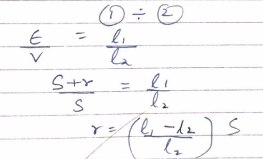
Let null point be obtained at a distance l1 from A

: E =Kl1 (1)

When key K2 is closed and K1 is open ,

Let null point be obtained at a distance l2 from A

V=Kl2 (2)

Where S is the shunt resistance in parallel with given cell .

l1 and l2 ; balancing length without & with shunt respectively .

r: internal resistance of the cell.

Procedure

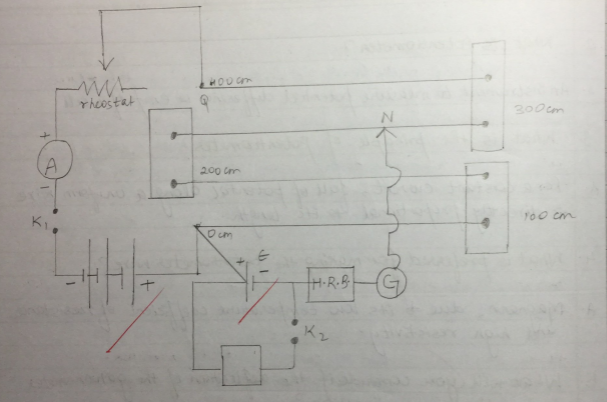
Make the connection as shown in diagram .

Clean the ends of the connecting wires with sand paper and make tight connection , tighten the plug of the resistance box .

Check the emf of the battery and cell and see the emf of the battery is more than that of the given cell other wise null or balance point wont be obtained (E` >E).

Take maximum current from battery , making rheostat resistance small.

Insert the plug key k , and adjust the rheostat so that a null point is obtained on the fourth wire of the potentiometer .

Insert the 2000 ohm plug in its position in resistance box and obtain a null point by slightly adjusting the jockey .

Measure the balancing length l1.

Take out the 2000 ohm plug from the resistance box . introduce the plug in the key k1 as well in key k2 .Take out a small resistance from the resistance box R connected in parallel with cell.

Slide the jockey along the potentiometer wire and obtain a null point

Insert the 200 ohm plug back in its position in RB and make further adjustment for sharp null point .

Measure the balancing length l2 from end P.

Remove the plugs key k1 and K2 . wait for some time and repeat the activity for the same current .

Record your observation

Circuit Diagram

Observation

Value of Shunt resistance (S in ohm) Balance Length l1 (K2 is open) without Shunt (cm) Balance length l2 with Stunt (K2 is closed) (cm) r = [(l1-l2)S]/l2 (in ohm) Mean ‘r’
1.5 171.4 64 1.67 1.77 ohm
2 171.3 61.5 1.78
2.5 171.1 59.6 1.87

Calculation

Mean ‘r’ = (1.67+1.78+1.87)/3 = 1.77 ohm

Result

The internal resistance (R) of given cell is 1.77 OHM

Precaution

For one set of observation the ammeter reading should be constant .

Current should be passed for short time .

Jockey should be rubbed against potentiometer wire .

Sources of error

The emf of the battery is less then the cell (E`<E)

Cell is disturbed during the experiment .

Viva Questions

What do you mean by the internal resistance of cell ?

It is the resistance offered by electrodes

What are the factors on which internal resistance of a cell depends ?

1 Nature of electrodes

2 Nature of electrolyte

3 concentration of electrolyte

4 Temperature of electrolyte

5 Distance between electrodes

6 Area immersed

Does the internal resistance depends on current drawn from the cell ?

Yes the internal resistance usually increases as more current is drawn fom the cell

Can we find the internal resistance of a secondary cell ?

No the internal resistance of a secondary cell is so small (0.01 ohm ) that this method can’t be used .

What should a cell not be disturbed during the experiment ?

Disturbing the cell may change the factors on which internal resistance depends

You can also get Class XII Practicals on BiologyPhysics, and Physical Education.

Determining resistance of a galvanometer by half deflection method and to find its figure of merit .

Aim : To determine resistance of a galvanometer by half deflection method and to find its figure of merit .

Apparatus : A Weston type of galvanometer , a voltmeter , a battery /battery eliminator , two 10,000 ohm and 200 ohm ) resistance boxes , two one way key , a rheostat , a screw gauge , a meter scale , an ammeter of given range , connecting wires and a piece of sand paper .

Theory

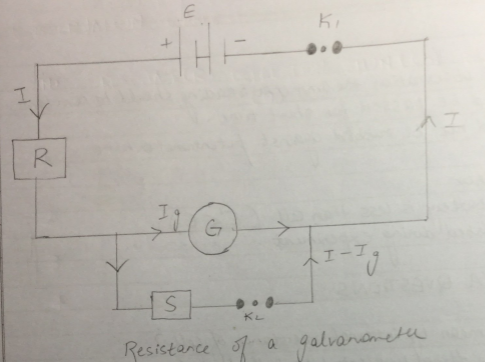
The resistance of the given galvanometer as found by half deflection method .

G= (RxS)/(R-S) (1)

Where R is the resistance connected in series with the galvanometer and S is the shunt resistance .

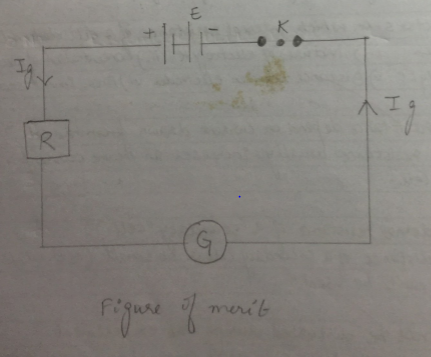
The figure of merit , K =E /[(R+G)Q] (2)

Where E is the end of the cell and Q is the deflection produced with resistance R.

The maximum current that can pass through the galvanometer , Ig=nk

Where n is the total number of dimension on the galvanometer scale on either side of zero .

Procedure

1. Resistance of galvanometer by half deflection method

  • Make the connections accordingly as shown in circuit diagram .
  • See that all plugs of the resistance boxes are tight
  • Take out the high resistance (200 Ohm ) from the resistance box R and insert key K1 only .
  • Adjust the value of R1 so that deflection is maximum , even in number and within the scale .
  • Note the deflection . Let it be Q.
  • Insert the key k2 also and without changing the value of R2 ,adjust the value of S , such that deflection in the galvanometer reduces to exactly half the value of resistance S.
  • Note the value of resistance S .
  • Repeat step 4 & 7 three times taking different R and adjusting .

2. Figure of merit

  • Take one cell of the battery and find its emf by a voltmeter by connecting +ve of the voltmeter with +ve of cell and – ve of the voltmeter with -ve of cell . Let it be E.
  • Take connection as in circuit diagram .
  • Adjust the value of R to obtain a certain deflection Q when circuit is closed .
  • Note the value of resistance R and deflection Q.
  • Now change the value of R and note the galvanometer deflection again .
  • Repeat the step with both cells of the battery with different voltages like 2,4,6 ,8 volts from battery eliminator.
  • Find the figure of merit K using the formula

Observation table

Resistance (R) Deflection (Q) Shunt (S) G =(RxS)/(R-S)
5000 10 5 5.005
10000 6 3 3
2000 20 10 10.05
1500 26 3 13.11
Average G = 7.79 ohms
Resistance (R) Deflection (Q) K
5000 9 0.556
10000 5 0.60
2000 20 0.502
1500 25 0.524
Average K = 0.5455 A/dn

Calculations

  1. G = (5.005+3+10.05+13.11)/4 [E = 1.45V]
  2. Figure of Merit : Current in the galvanometer per unit time
  3. K = IQ = [(E)/(R+G)]x[1/Q] – SI unit = AD division = 10-5 Al div

Result

Resistance of given galvanometer is 7.79 ohm .

Figure of merit of given galvanometer is 0.545 A/dn .

Precautions

All connections should be neat and tight .

The emf of cell / battery should be constant .

Source of error

The scene of the instrument may be loose .

The galvanometer division may not be of equal size.

Diagram

Resistance of Galvanometer

Figure of Merit

Viva question

What is the galvanometer ?

It is a device used for detecting feeble electric currents in circuit .

Define the figure of merit of a galvanometer ?

The quantity of current required to produce a deflection of one division in the galvanometer is called figure of merit of a galvanometer . It is represented by K . Its unit is ampere per division .

Why is this method called half deflection method ?

It is so because the deflection is made half by using a shunt resistance S.

Under what condition id the resistance of a galvanometer (E1) equal to shunt resistance (S)?

E1=S , only when series resistance R is very high .

You can also get Class XII Practicals on BiologyPhysics, and Physical Education.

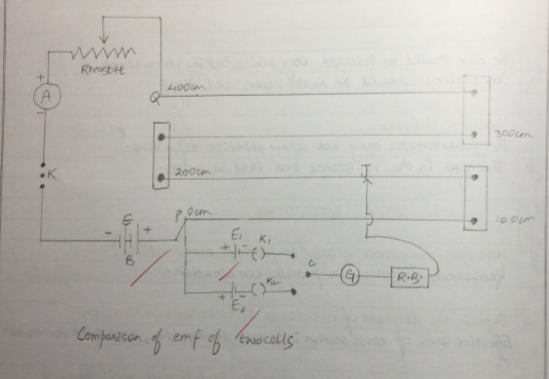
To compare EMF of two given primary cells using potentiometer

Aim : To compare EMF of two given primary cells using potentiometer

Apparatus : potentiometer , a leclanche cell , a daniel cell , an ammeter , a voltmeter , a galvanometer , a battery , (battery eleminator), a rheostat , of low resistance , a resistance box , a one way key , a two way key , a jockey , a set square , connecting wire , a piece of sand paper .

Theory

When we keep key (K1) closed and (K2) open , let the null point found be lAJ1

E1=KlAj1 (1)

When we keep K1 open and K2 closed , let null point obtained by lAJ2 .

E2=KlAj2 (2)

(1)/ (2)

E1 / E2 = KlAJ1 / KlAj2

E1/E2 =l1/l2

Where E1 and E2 are the emf of two given cells .

Procedure

  1. Arrange the apparatus as shown in the circuit diagram .
  2. Connect the positive poles of the cells to the terminal and the negative poles to the terminal a and b of the two way key .
  3. Insert the plug in the key K and also in between the terminals a and c of the two way key .
  4. Slide the jockey gently over the potentiometer wires until you obtain a point of no deflection .
  5. Note the length l1 at the point.
  6. Repeat this with E2 by disconnecting E1 and inserting plug into gap a and c of two way key .
  7. Record l2 at null point .
  8. Repeat this different resistance .

Observation table

Balancing Lengths E1 / E2 = lAJ1 / lAj2
L1 for cell E1 (cm) L2 for cell E2 (cm)
327 376 0.86
323.5 371 0.87
321.5 369 0.87
312.5 352.5 0.88

Result

The ratio of emf E1/E2 ~0.87

Precaution

      1. The connections should be neat, clean and tight.
      2. The plugs should be introduced in the keys only when the observations taken.
      3. The positive poles of the battery E and cells Ex and E2 should, all be connected to terminal at the zero of the wires.
      4. The jockey key should not be rubbed along the wire. It should touch the
      5. The e.m.f. of the battery should be greater than the e.m.f.’s of the either cells.
      6. Some high resistance plug should always be taken out from resistant the jockey is moved along the wire.

Sources of error

  1. The auxiliary battery may not be fully charged.
  2. The potentiometer wire may not be of uniform cross-section and material. throughout its length.
  3. End resistances may not be zero.

Diagram

compare emf cell

VIVA Question

What is emf of a cell?

Electromotive force of a cell is the potential difference across the terminals of the cells when it is in open circuit i.e. no current is drawn from the circuit .

What is potentiometer ?

An instrument to measure potentiometer difference or emf of a cell .

What is the principle of potentiometer ?

For a constant current , fall of potentiometer along a uniform wire is directly proportional to its length .

What is preferred for making potentiometer wire ?

Magnum , due to its low temperature coefficient of resistance and high resistivity .

What will you conclude if the deflection of the galvanometer is in the same direction ?

The positive terminals aren’t connected at one point

Potential difference between wires ends is less than emf of cells to be measured .

Emf of driving cells is less than that of cells to be measured .

You can also get Class XII Practicals on BiologyPhysics, and Physical Education.


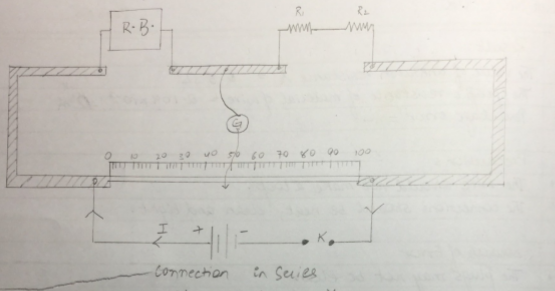
To verify the laws of combination (series) of resistance using a meter bridge (R=R1 + R2 )

Aim : To verify the laws of combination (series) of resistance using a meter bridge (R=R1 + R2 )

Apparatus : a meter bridge , a leclanche cell (battery eliminator ) , a galvanometer , a resistance box , a jockey , two resistance wire or two resistance coils , set square , connecting wires .

Theory

  1. The resistance (r) of a wire or coil is given by

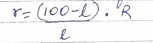
Where R is the resistance from resistance box in the left gap and l is the length of the meter bridge wire from zero end upto balance point .

2. When two resistance r1 & r2 are connected in series , then their combined resistance

R3=R1+R2

Procedure

  1. Mark the two resistance coil as r1 and r2 .
  2. To find the r1 and r2 proceed same way as in experiment 1.

(if r1 and r2 are not known )

  1. Connect the two coils r1 and r2 in series as shown circuit diagram in the right gap of meter bridge and find the resistance of this combination. Take at least three sets of observation.
  2. Record your observation.

Result

Within limits of experimental error , experimental and theoretical values of R  are same . Hence law of resistance in series is verified .

Precaution

  1. The key should be inserted only while taking observation .
  2. Connections should be neat and tight .

Sources of error

  1. The key in resistance box may be loose .
  2. The galvanometer may not show opposite deflection .


Circuit diagram

metre bridge series combination

Observation table

Resistance in R.B. (ohm) Balance l (cm) (100-l) (cm) [(100-l)*R]/l Mean r1 (cm)
0.5 24 76 1.583 1.616
1 38 62 1.631
2 55 45 1.636
Resistance in R.B. (ohm) Balance l (cm) (100-l) (cm) [(100-l)*R]/l Mean r2 (cm)
0.5 33 67 1.015 1.015
1 50 50 1
2 66 34 1.030
Resistance in R.B. (ohm) Balance l (cm) (100-l) (cm) [(100-l)*R]/l Mean rs (cm)
0.5 16 84 2.625 2.615
1 28 72 2.571
2 43 57 2.651

Calculation

R1 + R2 = 1.616+1.015 = 2.631 ohm
Rs = 2.615 ohm

Therefore, experimental error = [(2.615-2.631)/2.615]*100 = 0.6%

Viva question

How does resistance change in series combination ?

Ans. Resistance increase in series combination

Why does resistance increase in series combination ?

Ans. Effective length of resistor increases . As R*l , resistance increases .

What is resistance ?

Ans. it is the opposition offered by the material of two wire to flow of electric current .

What is the cause of resistance ?

Ans. it is the opposition offered by the material of wire to flow of electric current .

What is the effect of temperature In the resistance of conductor ?

Resistance of all conductor increases with increase in temperature .

You can also get Class XII Practicals on BiologyPhysics, and Physical Education.

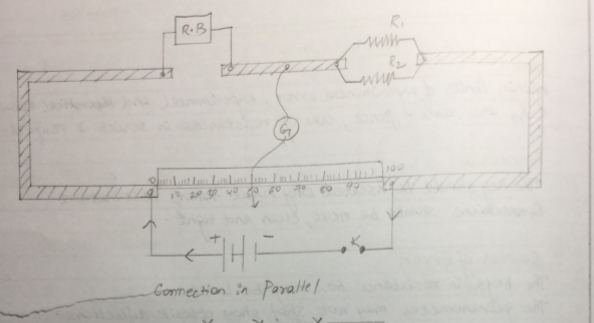
Verifying laws of combination (parallel) of resistance using meter bridge

Aim: To verify laws of combination (parallel) of resistance using meter bridge .

Apparatus: a meter bridge , a leclanche cell , a galvanometer , a jockey , a jockey , a resistance box , two resistance wire , connecting wires , set square .

Theory

The resistance (r) of a resistance wire or coil is given by r=(100-l)/L *R where R is the resistance from resistance box in the left gap and L is the length of meter bridge wire from O end upto balance point.

When r1 and r2 are connected in parallel , then their combined resistance

Rp = r1r2 /r1+r2

Procedure

  1. Mark the two resistance wires as r1 and r2
  2. Connect the two coils r1 and r2 in parallel as shown in fig. in the right gap of meter bridge and find the resistance of this combination . Take at least three set of observation
  3. Record your observation .

Result

Within limit of experimental error , experimental and theoretical values of Rp are same .

Hence law of resistance in parallel are verified .

Precaution

The key should be inserted only while taking observation .

Connection should be neat and tight .

Source of error

The galvanometer may not show opposite deflection

The key in the resistance box may be close .

OBSERVATION TABLE

Value of r1

Resistance of R.B. (ohm) Balance L (cm) (100-l) (cm) [(100-l)*R]/L Mean r1
0.5 59 41 0.347 0.6393
1 37 63 0.587
2 33 67 0.985

Value of r2

Resistance of R.B. (ohm) Balance L (cm) (100-l) (cm) [(100-l)*R]/L Mean r2
0.5 83.2 16.8 0.1009 1.729
1 80.8 19.2 4.208
2 69.4 30.6 0.881

Value of rp

Resistance of R.B. (ohm) Balance L (cm) (100-l) (cm) [(100-l)*R]/L Mean rp
0.1 27 73 0.27 0.36
0.2 32 68 0.42
0.5 56 44 0.39

Calculations

Rp = (R1R2)/R1+R2 = (0.693×1.729)/(0.693+1.729) = 0.4667 ohm

Experimental Error = [(0.36-0.4667)/(0.36)]*100 = 29.6%


metre  bridge

Viva question

1. How does resistance change in parallel combination ?

Resistance decrease in parallel combination

2. explain the decrease of resistance in parallel combination ?

Effective area of cross section increases as r x 1/A , resistance decreases .

3. Why should jockey not be pressed too hard on wire while sliding ?

Sliding the jockey with a hard press will scratch the wire and make its thickness non-uniform .Resistance per unit length of wire will be inconsistent as resistance depends on area of cross section .

4. What is the resistance of an open key ? Explain.

Open key has infinite resistance as it makes current zero (R=V/I)

5. Define unit of resistance .

SI unit of resistance is OHM or volt per ampere . 1 Ohm is the resistance of a conduction carrying 1 ampere current when potential difference maintained across its end is 1 volt .

You can also get Class XII Practicals on BiologyPhysics, and Physical Education.